
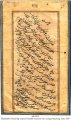
MS in Persian on buff paper, Iran, 1697, 1 f., 15 lines of a very early Shikasteh-i Nasta’liq script arranged diagonally across the page, 9 lines of Shikasteh-i Ta’liq script, within frames of gold, red and blue, Indian seal impression "He is All-Powerful, 1728-29".
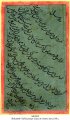
MS in Persian on blue paper, Shiraz, Iran, 17th c., 1 f., 34x21 cm, single column, (24x14 cm), 9 lines in Shikasteh-i Tal’liq script by Ali Akbar al-Musawi al-Mawlawi Al-Shirazi.
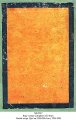
MS in Arabic on peach-coloured paper, Iran, 1708-09, 1 f., 33x21 cm, single column, (21x14 cm), 9 lines in Naskh script in gold, colophon of 2 lines in Riqa’ script in gold by Ahmad al-Nayrizi, autograph, signed.

MS in Persian on paper, Iran, 2 December 1187, 1 f., 28x15 cm, (25x13 cm), 9 long lines in Tawki’ script, signed, witnesses signatures. Provenance: 1. Sam Fogg, London.
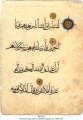
MS in Arabic on paper, Egypt, ca. 1300-1350, 4 lines in Rayhani script influenced by Muhaqqaq script, containing the word "ashar" (ten) in gold ornamental Kufic script.
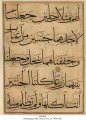
MS in Arabic on paper, Iraq or Iran, ca. 1350-1420, 5 lines in a large, very fine muhaqqaq script outlined in gold, within a frame of gold, red and blue, roundels containing gold knotwork, probably by Karamshah Tabrizi.
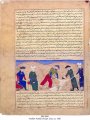
MS in Persian on paper, Herad, Iran, ca. 1425, 1 f., 43x34 cm, single column and 4 columns, (37x26 cm), 35 lines in naskhi script within a frame, 1 miniature 12x26 cm in full colours.
There are altogether 258 items in the Schøyen Collection that originate in China. In addition to the 11 manuscripts listed here, 145 items out of 150 in collection 21. Pre-Gutenberg printing, are also from China.
This section of the online collection covers all aspects of scribal activity, job descriptions, signed colophons, scribal illustrations, and equipment such as reeds, styli, inkwells and wax tablets.
The collection of some 800 magical manuscripts covers all continents spanning over 4,500 years. The oldest of these, from 26th c. BC from North Syria, has nine incantations by the first named author in history, Ur-Gibil, who was also a scribe, and wrote the text himself and signed it as well. This makes the present manuscript one of the first, if not the first, signed literary autograph.
The Mathematics Collection of around 380 manuscripts starts with the beginning of mathematics in the 27th c. BC, and ends with Einstein. Here, 24 examples - including counting tokens that preceded mathematics as a means of counting and accounting- are presented as an introduction to the origins of mathematics.
The details of 16 manuscripts are included in this section out of a collection of 90 law manuscripts in all, including the Ur-Nammu Code which predates the Hammurabi Code by some 300 years.