
CH'ANG LI
| MS | 2765/7 |
| MS Short Title | CH'ANG LI |
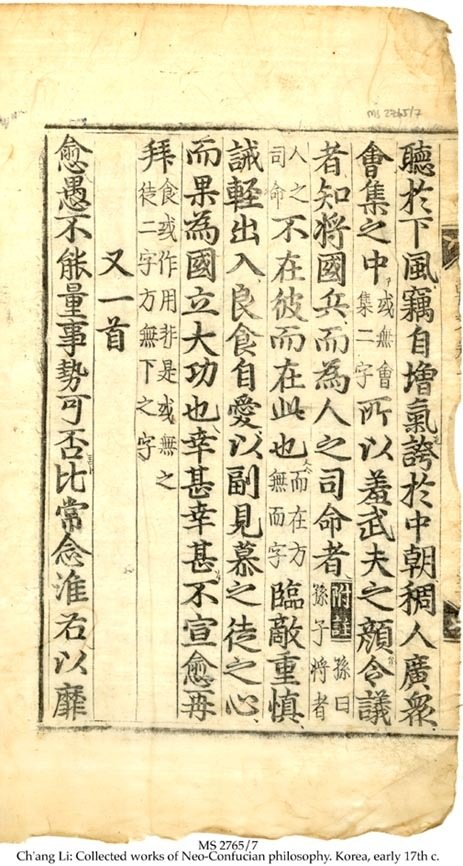
| Text | CH'ANG LI: COLLECTED WORKS OF NEO-CONFUCIAN PHILOSOPHY. REVISED BY CHU HSI |
| Description | Printed in Chinese on paper, Korea, early 17th c., 1 f., 33x21 cm, 9 columns, (26x17 cm), 16 characters in Chinese book script by movable wooden type Hullyon-Togam-Ja, Kyong-o-Ja style casted in 1594-1605. |
| Provenance | 1. Melvin P. McGovern, Los Angeles (-1966); 2. Björn Löwendahl, London. |
| Commentary | Neo-Confucian teachings were first introduced into Korea An Hyang, during the reign of Chungyol. An Hyang visited Peking in 1290 and returned to Korea with a copy of Chu Hsi's works and his portrait. Neo-Confucian philosophical and political thinking made ultra-conservatism the dominant characteristic of Korean society. Authority, as exemplified in the person of Chu Hsi, rather than reason, became the criterion of truth. The Korean philosopher Chong Mong-ju is regarded as the founder of Neo-Confucian thinking in Korea. He was the first scholar to elevate Korean Confucianism to the level of a true philosophical discipline. Each pose is illustrated and contains a short description of its function. The next method is called 'the meditation of the 24 solar terms', also illustrated and described. This type of meditation comprises 24 poses, each of which is supposed to remedy certain diseases. Two ancient Daoist exercises, recorded in the following pages, for the benefit of the internal organs, were written as verses, the last one composed in 948. |
| Place of origin | Korea |
| Dates | Early 17th Century |
- ADVANCED MANUSCRIPT SEARCH
- 1. Bible
- 2. History
- 3. Literature
- 4. Palaeography
- 4.1 Early Writing
- 4.2 Greek Book Scripts
- 4.3 Latin Book Scripts
- 4.3.1 Roman Scripts
- 4.3.2 National or Relgional Scripts
- 4.3.3 Carolingian Minuscule
- 4.3.4 Romanesque
- 4.3.5 Gothic
- 4.3.6 Italian & Humanistic
- 4.3.7 East European
- 4.4 Latin Documentary Scripts
- 4.5 Greek & Other
- 4.6 Aramaic, Hebrew & Syriac
- 4.6.1 Proto-Canaanite / Early Phoenician
- 4.6.2 Aramaic
- 4.6.3 Jewish Aramaic
- 4.6.4 Hasmonean Hebrew
- 4.6.5 Herodian Hebrew
- 4.6.6 Hebrew Square
- 4.6.7 Semi-Cursive Hebrew
- 4.6.8 Rabbinic Cursive
- 4.6.9 Samaritan
- 4.6.10 Syriac Estrangela
- 4.6.11 Syriac Sertâ
- 4.6.12 Syriac Rabbinic
- 4.6.13 Christian Palestinian Aramaic / Palestinian Syriac
- 4.6.14 Mandaic
- 4.6.15 Manichaean
- 4.6.16 Angelic Script
- 4.7 Arabic
- 4.8 Native American
- 5. Patristic Literature
- 6. Liturgy
- 7. Music
- MUSIC NOTATION
- 7.1 Sumerian Music
- 7.2 Babylonian Cuneiform
- 7.3 Ancient Greek
- 7.4 Byzatine Notation
- 7.5 Metz (Messine)
- 7.6 North French
- 7.7 Aquitanian Neumes
- 7.8 Palaeo-Frankish (St Amand)
- 7.9 St Gallen Neumes
- 7.10 Toscana Neumes
- 7.11 Bologna Neumes
- 7.12 Beneventan Neumes
- 7.13 Catalan Neumes
- 7.14 Cistercian Neumes
- 7.15 English Neumes
- 7.16 Metz-Gerrman Gothic
- 7.17 Hufnagel / German Gothic
- 7.18 'Tête de Marteau' Notation
- 7.19 Square Notation
- 7.20 Praha Notation
- 7.21 Estergom Notation
- 7.22 Wroclaw Notation
- 7.23 Mensural Notation
- 7.24 Tablature Notation
- 7.25 Old Russian Neumes
- 7.26 Osmanic Letter Notation
- 7.27 Vedic Numeric Hand
- 7.28 Koto Notation
- 7.29 Chinese Gongchi
- 7.30 Graphic Notation
- 7.31 Virtual Notation
- COMPOSERS AT WORK
- 7.32 Renaissance Music
- 7.33 Baroque Music
- 7.34 Classical Period
- 7.35 Romanticism
- 7.36 Modern to 1950
- 7.37 Contemporary
- 8. Law
- 9. Mathematics
- 10. Magical Literature
- 11. Calendars & Almanacs
- 12. Dead Sea Scrolls
- 13. Scribal Activity & Learning
- 14. Papyri & Ostraca
- 15. Bindings & Bookboxes
- 16. Seals
- 17. Apocryphal Literature
- 18. Nordic Countries
- 18.1 Norway
- MS 566/1
- MS 1385
- MS 2151
- MS 2116/2
- MS 2118/1
- MS 2526/3
- MS 2119/1
- MS 2113
- MS 2223/16 (Seals)
- MS 1281 (Music)
- MS 1576 (Palaeography)
- MS 2913 (Calendars)
- MS 2222/3 (Calendars)
- MS 2222/2 (Calendar)
- MS 1570 (Palaeography)
- MS 2128 (History)
- MS 2132 (Smaller Collections)
- MS 4473 (Smaller Collections)
- MS 2114 (Literature)
- MS 2526/1 (Literature)
- MS 2115/1 (Literature)
- MS 2120/4 (Smaller Collections)
- MS 2120/1 (Smaller Collections)
- MS 2526/2 (Smaller Collections)
- MS 2774 (Smaller Collections)
- MS 2138 (Smaller Collection)
- MS 4471 (Smaller Collection)
- MS 5272/1 (Smaller Collections)
- MS 2117/3 (Literature)
- MS 2140 (Smaller Collecitons)
- MS 2306 (Bible)
- MS 2255 (Smaller TBA)
- 18.2 Sweden
- 18.3 Denmark & Greenland
- 18.4 Finland
- 18.5 Iceland
- 18.1 Norway
- 19. Dictionaries & Lexical Texts
- 20. China
- 21. Pre-Gutenberg Printing
- 22. Buddhism
- 23. Religions
- 24. Smaller Collections
- 24.1 Architecture
- 24.2 Books of Hours
- 24.3 Letters
- 24.4 Legends & Proverbs
- 24.5 Children's Literature
- 24.6 Library Catalogues
- 24.7 Maps
- 24.8 Marine Life
- 24.9 Medical Texts
- 24.10 Miracles & Saints
- 24.11 Peerage Genealogies
- 24.12 Roman Military Diplomas
- 24.13 Ships & Seamanship
- 24.14 Slavery
- 24.15 Weights & Measures
- 24.16 Wine & Beer
- 24.17 Women Authors
- 24.18 Miscellaneous