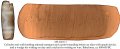
<< collection 15 | top of current | 17 >>

<< previous page | next page >>

16. SEALS (2)

16.4. OLD BABYLONIAN CYLINDER SEALS

MS 2784 Babylonia, 2000-1800 BC
MS 3357 Babylonia, 2000-1600 BC
MS 3335 Babylonia, 2000-1600 BC

16.5. ASSYRIAN & BABYLONIAN PERIOD CYLINDER SEALS

See also MS 1955/1, Syria, 1250-40 BC
MS 3021/1 Babylonia, ca. 800-600 BC
See also MS 1989, Assyria, ca. 7c. BC

16.6. HITTITE STAMP SEALS

MS 5160/1, Syria, 10th-8th c. BC

16.7. ROMAN PERIOD SEALS

See also MS 140, Egypt, 100 BC
MS 1912 Israel, 1st c. BC-1st c. AD
See also MS 4580, Afghanistan, ca. 450-500.

16.8. MEDIEVAL STAMP SEALS

MS 2223/ 14 England, 1st half 11c
See also MS 1648, England, ca. 1181-1188
See also MS 610, England, 1215
MS 2223/16 Norway or England, 1247-1266
MS 2223/401 England, 13c.
See also MS 590/26, England, 1297
See also MS 1783, England, 1311
See also MS 590/41, France, 1321
See also MS 1656, Scotland, 1417
MS 2223/368 England, 1430-1431
MS 2223/11 Isle of Man, 3rd quarter 15c.
See also MS 714 Hungary, 1464
MS 2223/13 England, 1595-1606

16. Seals

16.4 Old Babylonian Cylinder Seals

MS 2784 MS 2784
TO INANNA, WHO GRANTS A LIFE OF HEALTH TO THE ONE WHO WORSHIPS HER; LITERARY PRAYER
MS in Old Babylonian on black chlorite, Babylonia, ca. 2000-1800 BC, 1 cylinder seal, h. 2,7 cm, diam. 1,5 cm, 3 lines in an
extremely fine minute cuneiform script, with the Lamma goddess standing with hands raised in worship, facing a standing god or king, holding a mace, wearing a broad rimmed hat, from a top quality workshop.

Context: Hymns to Inanna are MSS 2367/1, 2367/3, 2647, 2698/1-2, 2784, 3286, 3301, 3376 and 3384.

Commentary: Literary texts are rarely found on cylinder seals.

back to top top
MS 3357 MS 3357
LITERARY PRAYER TO MARDUK


MS in Neo Sumerian on agate, Babylonia, 2000-1600 BC, 1 red banded cylinder seal, diam. 1,5x3,2 cm, single column, 4 lines in cuneiform script, with dedication scene.

back to top top
MS 3335 MS 3335
LITERARY PRAYER TO NIN SHUBAR, LORD OF THE LAMMAS


MS in Neo Sumerian on green stone, Babylonia, 2000-1600 BC, 1 cylinder seal, diam. 1,4x2,9 cm, single column, 4 lines in cuneiform script, with dedication scene.

back to top top

16.5 Assyrian & Babylonian Period Cylinder Seals

See also MS 1955/1, Rollsealed tablet, Syria, 1250-1240 BC

MS 3021/1  
CYLINDER SEAL WITH BATTLING ANIMALS RAMPANT AND A PRIEST STANDING BEFORE AN ALTAR WITH SPADE DEVICE, AND A WEDGE FOR WRITING ON CLAY AND A STYLUS FOR WRITING ON WAX

Cylinder seal on grey chalcedony, Babylonia, ca. 800-600 BC, 1 seal, h. 3,8 cm, diam 1,3 cm, showing battling animals rampant and a priest standing before an altar with the spade device representing Marduk, and 2 types of styli, a wedge for clay and a stylus for wax.
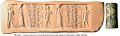
See also MS 1989, The Gilgamesh cylinder seal, Assyria, ca. 7th c. BC

MS 3021/1
back to top top

16.6 Hittite Stamp Seals

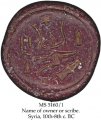
MS 5160/1

MS 5160/1

NAME OF OWNER OR SCRIBE

MS in Luwian on red jasper, Neo Hittite states, Syria, 10th-8th c. BC, 1 stamp seal, diam. 2,2x1,0 cm, 6+6 cursive Hittite hieroglyphs within a circle, same inscription on both sides, pierced for suspension.

Provenance: 1. Simmonds Collection UK (1944-1987); Pars Antiques, London.

Commentary: There are about 220 Hittite hieroglyphic signs, partly ideographic and partly phonetic, including 57 syllabic signs.

back to top top

16.7 Roman Period Seals

See also MS 140, Clay seal, Egypt, 100 BC

MS 1912 MS 1912
"TSADHE", THE HEBREW LETTER TS

MS in Hebrew on lead, Dead Sea area, 1st c. BC - 1st c. AD., 1 bulla, 2,1x1,2x0,6 cm, with a slightly oval impression, (1,2x1,1 cm), possibly an archaic Hebrew letter, tsadhe, to the left of the foot of an illustration the Menorah.

Context: The bulla was once attached to a document, that probably is lost.

Provenance: 1. Cave in the Dead Sea area (1st c.-1956); 2. Members of the Ta'amireh tribe, Judaean desert (1956); 3. Khalil Iskander Shakin ("Kando"), Bethlehem (1956-1957); 4. Private collector and descendants, USA (1957-1994).

Commentary: The bulla has not yet been researched. Its possible relation to the Judean desert materials has yet to be established. It might have been the seal impression attached to a contract or letter, either of one of the local leaders, or from a high official from, f. inst., Massada or even Jerusalem.

See also MS 4580, Bactrian clay seals, Afghanistan, ca. 450-500.

back to top top

16.8 Medieval Stamp Seal Matrices

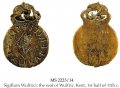
MS 2223/14
SIGILLUM WULFRICI; THE SEAL OF WULFRIC  

MS in Latin on walrus ivory, Kent, England, 1st half of 11th c., 1 seal matrix, diam. 4 cm, 5,4x4 cm, 1 line in Anglo-Saxon capitals, 3/4 length figure of a man, a sword in his right hand, facing left and pointing with his left hand; the handle carved with a bird-headed dragon intertwining with its bifurcating tail.

Context: This is one of five surviving seal matrices from before the Norman Conquest.

Provenance: 1. Wulfric (11th c.); 2. Discovered in a garden shed in Sittingbourne, Kent (1976); 3. Christie's 16.3.1977:179; 4. British Rail Pension Fund (1977-1996); 5. Sotheby's 4.7.1996:1.

Commentary: The seal was probably made for the use by a secular person of rank, possibly a thegn (noble) of King Ethelred II.

MS 2223/14

Published: 1. Janet Backhouse, D.H. Turner, Leslie Webster, eds.: The Golden age of Anglo-Saxon art 966-1066, p. 114, no. 113; 2. Elizabeth-Ann Hastings, "An Anglo-Saxon Seal Matrix", Burlington Magazine, vol. 119, 1977, pp. 308-9; 3. T. A. Heslop, "English Seals from the mid-ninth Century to 1100", Journal of the British Archaeological Association, 133, 1980, pp. 6-7; 4. English Romanesque Art 1066-1200, Hayward Gallery Exhibition, 1984, p. 317, no, 369; 5. J. Cherry, 7000 Years of Seals. ed. D. Collon, British Museum, 1997, p. 133, fig. 8/3; 6. Manuscripts in The Schøyen Collection, ed.-in-chief, Prof. Jens Braarvig. vol. IV: Medieval seal matrices. Ed. by Richard Linenthal and William Noel. Oslo, Hermes, 2004.

Exhibited: 1. British Museum, 1977-1996. 2. Hayward Gallery, London, March- July 1984.

See also MS 1648, Wax seals, England, ca. 1181-1188

See also MS 610, Wax seal, England, 1215

back to top top
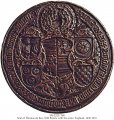
MS 2223/16  
S’ FINNONIS BARONIS REGIS NORWAGIE. (SEAL OF) Baron FINN, KINGDOM OF NORWAY  

MS in Latin on bronze, Mel near Bergen, Sunnhordland, Norway, or England, 1247-1266, 1 seal matrix, diam. 4,4 cm, 1 line in a formal Lombardic script, with armoured knight wearing helmet and brandishing a sword, mounted on a horse galloping right.

MS 2223/16
Context: The seal impression of baron Finn Gautsson was one of those attached to the Treaty of Perth of 1266, which ceded the Orkneys, Hebrides and Isle of Man from Norway to Scotland, after the Norwegian fleet was defeated by Alexander III at Largs in 1263. The other Norwegian signatories were Bishop Peter of Bergen; Bishop Torgils of Stavanger; Baron Andres Niklasson, Chancelor of the Norwegian king Magnus VI Lagabøter; and Baron Brynjol Jonnson. Neither of the 2 original treaty documents have survived. The original of the renewal of the treaty in 1312 is still in Edinburgh, H.M general Register House; printed in the Acts of Parliament I, p. 78, and in Diplomatarium Norvegicum XIX, no. 482.

Provenance: 1. Finn Gautsson, Mel, Sunnhordland, Norway (ca. 1247-1288); 2. Found in a field near Wymondham, Ashwellthorpe, Norfolk (-1996) by Alan Womack,; 3. Glendining's Cat. 2.10.1996:490.

Commentary: Finn was the son of Gaut Jonsson who died in 1270. Finn Gautsson is mentioned several times in Håkon Håkonsson's saga from 1247 onwards, and mentioned last time in a document from 1288. The origin of the seal is a thorny question. Artistic relations between England and Norway in the middle of the thirteenth century were extremely close. Matthew Paris, the artist and chronicler of St. Alban’s, for instance, went on a mission to the king of Norway at Bergen in 1248. The king was Haakon Haakonsson (1217-1263), who shared similar aesthetic interests with Henry III, King of England (1216-1272). Indeed, in 1236 Henry gave to Haakon a replica by the goldsmith Walter de Croxton of his own first Great Seal (of 1218, made by Walter de Ripa). Finn’s seal bears comparison not only with the best English work of c.1250 which is often associated with Westminster, but also with Norwegian panel painting, such as the mid-thirteenth century Ulvik altar frontal (University of Bergen, The Historical Museum). In both style and design, Norwegian seals are very similar to English ones at this period.

Published: Manuscripts in The Schøyen Collection, ed.-in-chief, Prof. Jens Braarvig. vol. IV: Medieval seal matrices. Ed. by Richard Linenthal and William Noel. Oslo, Hermes, 2004.

back to top top
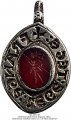
MS 2223/401 MS 2223/401
FRANGE:LEGE:TEGE

MS in Latin on silver, England, 13th c., 1 pointed oval face seal matrix, 2,3x1,8 cm, 1 line in Lombardic script, plain outer border, flat reverse with a bevelled edge, pierced suspension loop in the shape of a dragon's head with inset Roman cornelian stone, 1st. c. of "Mars Gradivus" (the god marching), nude apart from a helmet and loin-cloth/scarf and carrying a spear and trophy.

Context: For comparable examples of this common type see M. Henig, "A Corpus of Roman Engraved Gemstones from British Sites", British Archaeological Reports, British Series 8, 2nd ed., Oxford, 1978, nos. 70-74, app. 71, app. 86, app. 98.

Provenance: 1. Found in Essex; 2. Bernard Quaritch Ltd., London.

Published: Manuscripts in The Schøyen Collection, ed.-in-chief, Prof. Jens Braarvig. vol. IV: Medieval seal matrices. Ed. by Richard Linenthal and William Noel. Oslo, Hermes, 2004.

Commentary: MSS 2223/398-401 are set with classical Roman intaglios. The magical powers of different stones were codified in the medieval Lapidary, a text particularly popular in England in the 13th c., and engraved gems assumed an even greater amuletic character. The re-use of Roman gems in seal matrices was widespread in the Middle Ages. In addition to their amuletic properties, intaglios were well adapted to their original purpose of making an impression on a sealing, and they were readily mounted in silver and gold for an important and wealthy clientele. They were seldom set in more ordinary bronze since the heat required to make the setting probably would have cracked the gem. A great number of gems found in English medieval settings are from before the Roman Conquest of Britain in AD 43, which suggests that although some were found on Roman sites in Britain many were imported during the Middle Ages.

See also MS 590/26, Wax seal, England, 1297

See also MS 1783, Wax seals, England, 1311

See also MS 590/41, Papal bull with lead seal, France, 1321

See also MS 1656, Wax seal, Scotland, 1417

back to top top
MS 2223/368
SIGILLU[M]: THOME: D[OMI]NI: DE: ROOS. + :DE :YTRULUOUS(?): DE :HAMELAK: DE :VALIBUS: + :DE :DAUSBENEY; SEAL OF THOMAS DE ROS, 10TH BARON, WITH HIS ARMS

MS in Latin on copper alloy, England, 1430-1431, 1 circular face seal matrix, diam. 6,5 cm, 1 line in black-letter script, a central shield with the arms of Roos surmounted by a peacock, two shields of arms on each side, arabesque ornament in the background composed of foliage, tendrils, and bunches of grapes, inner border with small quatrefoils, plain outer border, flat reverse with a mark where the original handle has been removed.

Context: An impression of the seal, dated 1431, is described by Birch, vol. 3, p. 451, no. 13,091. Compare the small motto seal of Thomas, Lord de Roos (Ellis P1962).

Provenance: 1. Thomas de Ros (1430/1431-1464); 2. Quaritch, London.

MS 2223/368

Commentary: The elaborate heraldic seal of Thomas de Ros, Lord Ros (1427-1464). The 10th Baron succeeded to the title while still a minor in 1430 on the death of his father in France in the service of Henry VI. He himself fought in the Wars of the Roses, serving under Henry VI (he fought at the first battle of St. Albans, 22 May 1455, considered the commencement of the civil wars) and Edward IV. In 1464 he was one of a force of Lancastrians in the company of Henry VI which was defeated at Hedgley Moor. He was captured in a wood, taken to Newcastle, and executed on 17 May 1464. For details see G.E.C., vol. XI, pp. 105-6.

Published: Manuscripts in The Schøyen Collection, ed.-in-chief, Prof. Jens Braarvig. vol. IV: Medieval seal matrices. Ed. by Richard Linenthal and William Noel. Oslo, Hermes, 2004.

back to top top
MS 2223/11
S': THOME: DEI: GRACIA: EPISCOPI: MANNENCIS; SEAL OF THOMAS, BISHOP OF MAN

MS in Latin on copper alloy with polished brass colour, Isle of Man, England, 3rd quarter of 15th c., 1 oval seal matrix, 7,4x4,5 cm, 1 line in black-letter script, full-length figure of a bishop holding a staff within an elaborate gothic architectural surround, a smaller three- quarter length figure of the bishop praying in a niche below, pearled inner and outer borders, flat reverse with a slight ridge and pierced handle.

Provenance: 1. Thomas, Bishop of Man (3rd quarter of 15th c.); 2. Found Minster, Sheppey, Kent (ca. 1740); 3. Bernard Quaritch Ltd., London.

Commentary: The bishop is identified by Birch as Thomas Burton (or Barton), 1455-58 ( impressions of the seal are nos. 2532-5, vol. I, p. 420). Another possible candidate is Thomas of Kirkham, former abbot of the Cistercian abbey of Vale Royal in Cheshire, bishop 1458 - c.1480 (A. W. Moore, Diocesan Histories. Sodor and Man, 1893, p. 95). Black-letter script is an angular gothic style script used after 1350.

Published: Manuscripts in The Schøyen Collection, ed.-in-chief, Prof. Jens Braarvig. vol. IV: Medieval seal matrices. Ed. by Richard Linenthal and William Noel. Oslo, Hermes, 2004.

MS 2223/11

See also MS 714, Wax seal, Hungary, 1464

back to top top
MS 2223/13
SIGILL: COMIT. PALATINI DUNELM AD BRIA ET ALIA IN EODEM COM: SIGILLANDA DEPUTAT, SIGILL COMIT. PALATINI DUNELM AD BRIA ET ALIA IN EODEM COM: SIGILL: DEPUTAT; SEAL OF THE CHANCELLOR OF THE COURT OF PLEAS OF DURHAM

MS in Latin on brass mounted on copper alloy, Durham?, England, 1595-1606, 1 circular seal matrix, diam. 7 cm, 1+1 lines in square capitals, the Chancellor of the Court of Pleas of Durham on the obverse in cap and cloak enthroned beneath an arch and holding a book, above a shield with the arms of the See of Durham against a ground with floriate scrolls; on the reverse an equestrian figure facing left in armour and with ostrich-plumed helmet, pearled outer borders, plain inner borders. The matrix is composed of two parts which fit together with projecting lugs with holes and pegs; each part is made in two pieces: the faces are engraved in brass and attached to outer plates which incorporate the lugs.

MS 2223/14

Provenance: 1. Court of Pleas of the County Palatine of Durham (1595-1606); 2. Found Herne Bay area, East Kent; 3. Bernard Quaritch Ltd., London.

Commentary: The seal matrix for the Court of Pleas of the County Palatine of Durham, from the bishopric of Tobias Matthew, Bishop of Durham from 1595 - 1606. The design is modelled closely on episcopal seals of the same period and was used for sealing writs that were issued by the Court of Pleas.

Published: 1. C. H. Hunter Blair, "Post-Reformation Ecclesiastical Seals of Durham", Archaeologia, Society of Antiquaries, 2nd ser., vol. 77 (1927), p.176, plate XX, nos. 1-3, described as a Chancery seal. 2. Manuscripts in The Schøyen Collection, ed.-in-chief, Prof. Jens Braarvig. vol. IV: Medieval seal matrices. Ed. by Richard Linenthal and William Noel. Oslo, Hermes, 2004.

back to top top

>> APOCRYPHAL LITERATURE