16. Seals
16.1 Neolithic Stamp Seals
| MS 3180 |
|
| STAMP SEAL, SCORPION(?) WITHIN AN OVAL OUTLINE |
 |
MS on clay, North Syria/highland Iran, 7th-6th
millennium
BC, 1 oval stamp seal, 4,9x4,0x3,9 cm, with gable handle pierced through.
Commentary: The earliest
Neolithic stamp seals were
made of clay. Very few therefore survive. |
top
| MS 2407/13 |
|
STAMP SEAL, QUATREFOIL/MALTESE CROSS WITH INFILL, WHIP OR
SNAKE |
 |
MS on grey steatite, North Syria/North Iraq/Iran, 5th millennium BC, 1
square stamp seal, 3,0x3,5x0,6 cm, 1 pictographic sign on reverse, pierced
through.
|
top
| MS 2411/1 |
|
| STAMP SEAL, STANDING MALE FIGURE BETWEEN 2 HORNED QUADRUPEDS
BACK TO BACK AND HEAD TO END |
MS on speckled dark-olive steatite or chlorite, North Syria/Iraq/Iran,
5th-4th millennium BC, 1 circular stamp seal, diam. 8,4x1,3 cm, pierced
through.
Commentary: The earliest stamp seals of Sumer had various geometric
patterns, later more elaborate designs and illustrations like the present
seal, as a proof of identity and ownership. These can, together with the
counting tokens, possibly be considered forerunners to the pictographic script
of ca. 3200 BC, see MSS 3008, 2726, 2424
and 4522/1. |
 |
top
| MS 2409/01 |
 |
| STAMP SEAL, LARGE IBEX WALKING LEFT |
MS on black steatite or chlorite, North Syria or Anatolia, 4th millennium
BC, 1 rectangular gabled stamp seal, 4,7x5,1x1,3 cm, pierced through. |
| |
top
16.2 Near Eastern & Sumerian Cylinder Seals
See also MS 4631,
Rollsealed bulla-envelope, Syria/Sumer/Highland Iran, ca.
3700-3200 BC
See also MS 4632,
Rollsealed bulla-envelope, Syria/Sumer/Highland Iran, ca.
3700-3200 BC
See also MS 4638,
Rollsealed bulla-envelope, Syria/Sumer/Highland Iran, ca.
3700-3200 BC
See also MS 4523,
Rollsealed bulla, Syria?, ca. 3500-3200 BC
See also MS
2963, Rollsealed tablet, Sumer, ca. 3300-3200 BC
See also MS
2726, Rollsealed tablet, Sumer, 32nd c. BC
| MS 3020/1 |
|
| JEMDET NASR CYLINDER SEAL, WITH VEGETATION, FLAX AND REED
STALKS |
 |
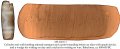
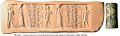
Cylinder seal on black chlorite, Sumer, ca. 31st c. BC, 1 seal, h. 2,8 cm,
diam 2,0 cm, showing 2 types of vegetation flax and reed stalks.
Context: For a Jemdet Nasr cylinder seal impression, see MS 3019/2.
Commentary: A very unusual design. The 2 signs had contemporary parallels with the pictographic signs NAGA and GI4. |
top
| MS 2077 |
|
| LIST OF SHEEP, LAMBS AND GOATS ASSIGNED TO VARIOUS RELIGIOUS
RITES, DATED MONTH PA'U'E, A YEAR OF IBBI-SÎN |
 |
MS in Neo Sumerian on clay, Umma, Sumer, reign of King Ibbi-Sîn, 2029-2004
BC, 1 tetrahedral bulla, h. 6,7 cm, 9,5x9,5x9,5 cm, single column, 39 lines in
cuneiform script by the scribe Gududu son of Dadaga, standard presentation
scene seal impression of the scribe's seal, with a Lamma goddess, gripping the
wrist of the scribe behind her, and a 2-line inscription, with hole for the
rope in the middle.
Context: Seal of Gududu son of Dadaga is on MSS 1947/05 and 2077. He
is mentioned on MS 1947/01.
|
top
16.3 Egyptian Cylinder & Stamp Seals
| MS 1721 |
|
| SEAL OF THE SON OF NEITH, CIVIL SERVANT |
|
MS in archaic Egyptian on black stone, Egypt, 1st or 2nd dynasty, ca.
3100-2700 BC, 1 roll seal, h.1,7 cm, diam. 1,6 cm, 1 line of 7 hieroglyphs.
Provenance: 1. I. Beekmans-Borgmeijer, Borken, Germany (1965-1992); 2. Nicholas Wright, London (1992-1993); 3. Jeremy Griffiths, Oxford.
Commentary: Hieroglyphs of the Archaic period are particularly difficult to read. One or two might be unattested. Rolls seals of this period are almost only to be found in public collections. |
 |
top
| MS 2934/2 |
 |
| TUTANKHAMON'S SIGNET
WITH THE PHARAO'S NAME |
MS in Egyptian on blue faience, Egypt, 1333-1323 BC, 1 oval cartouche
shaped stamp seal, signet in a 20th c. gold ring with rich filigree work,
1,5x1,0 cm, 1 line in hieroglyphs.
Context: Found with MS 2934/1.
Provenance: 1. Pharao Tutankhamon, Egypt (1333-1323 BC); 2. Excavated in Egypt by Harold Jones (1907); 3. Ian Fleming, England and Jamaica (1930'es-1964); 4. Caspar Fleming, London (1964-1975); 5. T. Eva collection, England; 6. Pars Antiques, London & Bruce Ferrini, Akron, Ohio: A selection of Cuneiform Tablets, Cylinder Seals, Medival & Renaissance Illuminated Manuscripts & Objects, exhibited at TEFAF Maastricht 12-21 March 1999, CU134A, acquired Jan. 2000. |
Commentary: When Tutankhaten instituted his worship of the sun and other gods, his name was changed to Tutankhamon and his signet , MS 2934/1, became obsolete and was substituted with the present signet , which is well used with its lower edge chipped off, and has been discarded. It was therefore not included with his other treasures in his burial. Carter's famous discovery of Tutankhamon's tomb in the Valley of Kings in Luxor was in 1922, 15 years after Harold Jones excavated the 2 signet rings. |
 |
top
>> SEALS (2)