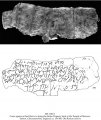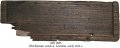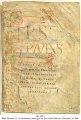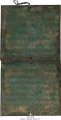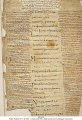
- MS 565/1 Italy, mid 4th c. BC
- MS 2032 Roma, 70
- MS 1835 London, early 2nd c.
- MS 1720/1 England, ca. 150-300
ETRUSCAN NAMES FROM HOMER, THE ILIAD: ELSANTRE (PARIS ALEXANDROS), TURAN (APHRODITE), MENERVA (ATHENE), AND UNI (JUNO, HERA)
![]()
MS in Etruscan on bronze, Vulchi, Etruria, Italy, mid 4th c. BC, 1 mirror, diam. 18 cm, engraved names in Etruscan script, with engravings of high quality of the Judgement of Paris from Homer's Iliad.
Context: For other Etruscan inscriptions, see MSS 564 and 565/2.
Provenance: 1. Friz Hugelmann, Ascona.
Commentary: From the "Perugia group" of 5 mirrors of this motive. One of these is published in: Maja Sprenger, Gilda Bartoloni: Die Etrusker, Kunst und Geschichte, München, Hirmer Verlag, p. 152, no. 237.
FLEET DIPLOMA GIVEN BY EMPEROR VESPASIAN TO THE VETERAN SAILOR DERNAIUS DERDIPILI F. DACUS (OF THRACE) AFTER 26 YEARS OF SERVICE IN THE RAVENNA FLEET UNDER THE COMMAND OF SEXTUS LUCILIUS BASSUS. COPIED AND CHECKED FROM THE BRONZE TABLET SET UP IN ROMA ON CAPITOL, ON THE WALL BEFORE THE SHRINE OF THE GENIUS OF THE ROMAN PEOPLE. WITNESSES: Q. ANTISTUS Q. F. SERGIA TRIBU RUFUS CLODIANUS PHILIPPIENSIS EQ R., C. VETTIDUS RASINIANUS, L. VALERIUS NASONIS PHILIPPIENSIS, P. VETTUS PIERUS PHILIPPIENSIS, M. VIBUS MACEDONIS VETERANUS; C. CAISUS LONGINUS VETERANUS; C. JULIUS AQUILAE APRENSIS
![]()
MS in Latin on bronze, Roma, 26 February 70, 2 tabellas (complete), 14,8x13,4 cm, single column, 8+10+18+10 lines in Latin capitals, 2 holes through each tablet with the wire that binds the two tablets together, originally secured with the seals of the 7 witnesses, 2 holes with complete hinge wires.
Binding: Barking, Essex, 1995, red cloth gilt folding case, by Aquarius.
Context: There are 3 praetorian diplomas (MSS 1801, 1870, 2051/7) in The Schøyen Collection, further 11 auxiliary diplomas (MSS 1836, 1899, 2051/1-6, 2051/8, 2052, 2086), and 3 fleet diplomas (MSS 698, 1921, 2032).
Provenance: 1. Dernaius Derdipili f. Dacus, Thrace (70 until his death); 2. Bernard Quaritch Ltd., London.
![]()
Commentary: The present diploma gives Dernaius Derdipili f. Dacus an honourable discharge from the navy of Emperor Vespasian, Roman citizenship for himself and his descendants, and the right of legal marriage.
The naming of Sextus Lucilius Bassus as commander of the Ravenna fleet places the diploma in an historical context, and casts an interesting light on Vespasian's political skills; as described in Tacitus Histories, II, 100,6; III, 12,2-8; III, 50; IV, 3,1-2; and Josephus Bell. Iud. VII, 6,1(163); VII, 8,1(252).
This MS is the first diploma issued by Vespasian. It is also one of the very few diplomas with the original string and hinge wires preserved.
The present MS contains the unusual information, of both year, place and the exemplar copied.Published: Margaret M. Roxan & Paul Holder: Roman Military Diplomas, IV. Institute of Classical studies. London, 2003. no 203, pp. 392-393..
Exhibited: 1. "Preservation for access: Originals and copies". On the occasion of the 1st International Memory of the World Conference, organized by the Norwegian Commission for UNESCO and the National Library of Norway, at the Astrup Fearnley Museum of Modern Art, Oslo, 3 June - 14 July 1996; 2. Kistefos-museet, Jevnaker: Romerske portretter i gull og marmor, 22 mai - 25 september 2005.
![]()
PRAETORIAN DIPLOMA GIVEN BY EMPEROR PHILIP THE ARAB AND HIS SON TO MARCUS AFRANIUS QUINTIANUS OF AELIA MURSA, AFTER 26 YEARS OF SERVICE WITH THE 1ST COHORT OF THE PRAETORIAN GUARD, UNDER THE CONSULS GAIUS BRUTTIUS PRAESENS AND GAIUS ALLIUS ALBINUS. COPIED AND CHECKED FROM THE BRONZE TABLET SET UP IN ROMA ON THE WALL BEHIND THE TEMPLE OF AUGUSTUS, NEAR THE STATUE OF MINERVA
MS in Latin on bronze, Roma, 7 January 246, tabella I, 13,7x9,9 cm, single column, 23 lines in rustic Latin capitals, 2 holes through the tablet for a wire that originally bound the two tablets together, secured with the seals of the 7 witnesses.
Binding: England, 1994, beech wood box.
Context: There are 3 praetorian diplomas (MSS 1801, 1870, 2051/7) in The Schøyen Collection, further 11 auxiliary diplomas (MSS 1836, 1899, 2051/1-6, 2051/8, 2052, 2086), and 3 fleet diplomas (MSS 698, 1921, 2032). 27 other praetorian diplomas are known. One, British Museum, CIL XVI 151 was issued on the same day to another veteran from Aelia Mursa.
Provenance: 1. Marcus Afranius Quintianus, Aelia Mursa, N. Slovenia (246 until his death); 2. Found in South-East Hungary; 2. Charles Ede cat. Writing & lettering in antiquity, 16(1994):32.
Commentary: The present diploma gives Marcus Afranius Quintianus an honourable discharge from the praetorian guard of Emperor Philip the Arab, Roman citizenship for himself and his descendants, and the right of legal marriage.
The present MS contains the unusual information, of both date, place and the exemplar copied.
The exemplar, the bronze tablet set in the wall on Forum Romanum, still survives in fragments.
The inner face of the tabella should have the same text as on the outer face to prevent fraud, but by the 3rd c. the inner faces of diplomas were increasingly carelessly engraved. Both this diploma and the British Museum one issued on the same day, have meaningless marks on the inner faces, as if the scribes knew that they were never to be opened.Published: Margaret M. Roxan: Roman Military Diplomas, 1985-1993, (III), no. 199.
![]()
BIBLE: ROMANS 1:1 - 6, LECTIONARY, READING OF THE EVE OF THE NATIVITY, WITH FURTHER READINGS OF ISAIAH 62:1 - 4, AND MATTHEW 1:18 - 19, FOR USE IN THE EUCHARIST
MS in Latin on vellum, Germany?, ca. 900, 1 f., 22x16 cm, single column, (21x9 cm), 23 lines in a sloping Carolingian minuscule by an insular scribe, 8 lines of rustic capitals, letters in the 2 first words in large capitals in painted gold, 2 2-line initials, a full page initial F, in red with interlace ornament infilled with green and red.
Provenance: 1. Sam Fogg Rare books ltd, London.
Commentary: The stately, massive initial F, has a dotted outline of the insular style used by Irish and English scribes, probably one working in the scriptorium of a monastery in Germany founded by the Irish missionaries.
See also MS 074, Psalms, Italy, 2nd half 9th c.
DOCUMENT OR LETTER
![]()
MS in Latin on wood, Walbrook, London, early 2nd c., 1 tablet, 5x15 cm, 4-5 lines in old Roman cursive.
Context: 6 further wooden wax tablets from Walbrook, London, excavated in 1934 and 1953, now at British Museum, and 1 found in 1986, dated 14 March 118, is in Museum of London.
Provenance: 1. Walbrook, London (2nd c.-1934); 2. Found in the City of London (1934); 3. Bernard Quaritch Ltd., London.
Commentary: A typical Roman wax writing tablet, used more than once, so the traces of lines are illegible, but single letters can be recognised (e.g. C and S). The 2 layers of writing can be seen on the wood where the metal stylus has penetrated the original wax covering.
British tablets are usually from the period 75-125 AD, but this may be an accident of survival, since wax tablets were used throughout the Roman period and for long afterwards. The Walbrook and Vindolanda tablets are the oldest group of written documents known from Britain. The Walbrook crossed the Roman city from north to south, joining the Thames at Vintry. Its banks were revetted with dumped material, including discarded writing tablets.
Roman wax tablets were usually made from silver fir (abies alba), not a wood native to Britain, but ideal for the purpose since it splits cleanly and evenly into boards ca. 10 mm thick.
The tablets were used for note-taking, for letters, and for legal documents.
The ORC and LRC, together with half-uncial, form the basis for the later national scripts in Europe, and examples are not recorded in any other known private MS collections, apart from The Schøyen Collection MSS 1706/1-2, 1720/1-6, and 1835.
CURSE: TO THE GOD MERCURY ARVERIUS. I COMPLAIN TO YOU, LORD, CONCERNING MY PROPERTY, A CLOAK AND HOOD. WHOEVER STOLE THIS, WHETHER SLAVE OR FREE, WHOEVER STOLE THIS, THE GOD IS NOT TO LET THEM STAND OR SIT, DRINK OR EAT, UNLESS THEY REDEEM IT AT YOUR TEMPLE WITH THEIR OWN BLOOD
![]()
MS in Latin on lead, Tarlton, Gloucestershire, England, ca. 150-300, 1 tablet, 3,5x11,0 cm, 6 lines in Late Roman cursive.
Context: Of the 8 curse tablets MS 1720/1-6 were found together near Tarlton. Many of the tablets found at Bath, very close to Tarlton, are written in the same style, but the "M" and the "R" are unusual in this tablet. This is the 3rd largest hoard of curse tablets found in England, next to the Bath and Uley hoards.
Provenance: 1. Tarlton hoard, Gloucestershire; 2. Nicholas Wright, London (- 1993); 3. Jeremy Griffiths, Oxford.
Commentary: There are several interesting dialect spellings, possibly reflecting features of the version of Latin written and spoken by the British tribe of the Dobunni. The ORC and LRC, together with half-uncial, form the basis for the later National scripts in Europe, and examples are not recorded in any other known private MS collections, apart from MSS 1706/1-2, 1720/1-8, and 1835.
Published: To be published by Prof. R.S.O. Tomlin.
See also MS 046, Ezekiel, Italy, 5th c.
BIBLE: MATTHEW 6:23 - 28; 8:8 - 16
![]()
MS in Latin on vellum, Italy, 6th c., 2 partial ff., 32x7 cm, originally 32x26 cm, 1 of 2 columns, (25x7 cm, originally 25x24 cm), 26 lines in a regular stately Latin uncial, written "per cola et commata".
Binding: New York, ca. 1974, red morocco gilt folding case by Nello Nanni.
Context: Recovered from the side of the spine of the binding of: Joannes Leunclavius: Jus Graeco-Romanus, vol. 2, Frankfurt am Main: Peter Fischer, 1596, in its original German binding of vellum over boards, sewn on 7 double cords, still present. Only survival of a Gospel book of ca. 200 ff.
Provenance: 1. Lord Herbert of Cherbury, England (1583-1648) and his descendants; 2. The Earl of Powis, England (until 1967); 3. Sotheby's 10.7.1967:20; 4. H.P. Kraus "Monumenta Codicum Manuscriptorum" cat. (1974):2.
Commentary: CLA suppl.: 1801. Written space and script show marked similarity to the Ancona Gospels of St. Marcellinus, mid 6th c., CLA III:278, according to E.A. Lowe.
Exhibited: Conference of European National Librarians, Oslo. Sept. 1994.
See MS 046, Ezekiel, Italy, 5th c.
BIBLE: PSALMS 99:3 - 4; 100:1 - 8, GLOSSED, FROM "THE ST. ROMUALD PSALTER"
![]()
MS in Latin on vellum, North Italy, mid 9th c., 1 f., 27x21 cm, single column (text), (27x7 cm), with marginal gloss on both sides, 25 lines in an ornate, uneven half uncial (text), ca. 60 lines in a cramped Carolingian minuscule (gloss).
Context: "The St. Romuald Psalter" is still in the Sacristry at the Monastery of San Salvatore, Camaldoli, 1 f. in Dillingen-an-der-Donau: Studienbibliothek, Fragm. 25. MSS owned by saints: MSS 260/36, 620, 639, 1000 and 1751.
Provenance: 1. Camaldolesian Monastery, Camaldoli, Toscana (9th c. - ca. 1700); 2. Camaldolesian Convent of Santa Maria degl'Angioli, Firenze (ca. 1700 -); 3. Aldo Olschki, Firenze (1959); 4. Bernard Rosenthal Collection, San Francisco I/78 (1959-1989); 5. Quaritch Cat. 1147(1991):5.
Commentary: The Psalter was complete when the palaeographer Jean Mabillon saw it at Camaldoli in 1686. An inscription on the cover recorded that it was written by St. Romuald, founder of the Camaldolesian order. St. Romuald died as late as 1027, almost 2 centuries after it was written. The MS was later taken apart for the use as relics to other Camaldolese houses.
See also MS 078, Eugippius: Excerpta ex Operibus S. Augustini, Germany, 825-850