4. Palaeography
4.3. Latin Book Scripts
4.3.2 National or Regional Scripts
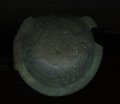
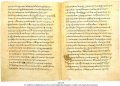
These developed from Roman cursive and half uncial, and most scripts lasted until the Carolingian reform around 800. The exceptions are Visigothic (until 12th c.) and Beneventan that survived until first half of 16th c. (see MS 1981). Runes, deriving from Roman capitals and other early scripts, lasted to 18th c. and is still not entirely out of use, and finally, Irish minuscule which still is used.
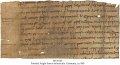
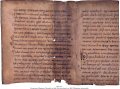
Luxeuil Minuscule
| MS 1361 |

|
| BIBLE: JOB 33:23 - 30, GREGORIUS MAGNUS: MORALIA IN JOB BOOK
XXIV, CH. 11-12 |
| MS in Latin on vellum, Luxeuil, France, early 8th c., 2 ff., 23x15 cm,
single column, (17x10 cm), 18 lines in Luxeuil minuscule, initials in
Merovingian capitals and Merovingian uncial, 2 decorated initials. |
|
Context: The main MS is British Library Add 11878 and 41567 (79 ff.). Other leaves in Bibliothèque Nationale N.A. Lat. 2243 & 2388 (4 ff.) and Cambridge Massachusetts, Houghton Library, MS Typ. 592 (6 ff.).
Provenance: 1. Benedictine Abbey of St. Peter, Luxeuil, Besançon (from early 8th c.); 2. Pierre Berès sale 10.6.1991:2; 3. Bruce Ferrini, Akron, Ohio.
Commentary: According to E.A. Lowe, only 31 MSS written in Luxeuil minuscule have survived. All except two are in public collections.
Cf. CLA no. 163: vol. II p. 13, V p. 49, Suppl. 24.
Exhibited: Comité International de Palaéographie Latin (CIPL) at Senate House, University of London , 3 September 2008. |
top
Merovingian Minuscule
| MS 2081 |
|
| BIBLE: 2 TIMOTHY 2:12 - 18; THEODORI EPISCOPI MOPSUENSTENI:
COMMENTARII IN EPISTOLAS PAULI |
MS in Latin on vellum, Corbie region, France, 750-800, 2 ff., 30x25 cm,
single column, (26x19 cm), 27 lines in a very fine Merovingian minuscule,
running titles in 12th c. script, headings in large red uncials, several
initials in pale red or brown.
Context: From the same MS as CLA Addenda no. 1878, and Sotheby's 22.06.1999:14.
The Latin text of Theodore of Mopsuestia, with inserts from Ambrosiaster for the gaps, is known in 2 earlier MSS and 2 fragments from a third copy only. They are 1. British Library Harley MS.3063, written at Corbie, 750-800, 2. Vatican, Vat.Lat.340 (a flyleaf) and Bibliothèque Nationale ms.lat.17177, fols.5-12, all from the same 8th-9th c. copy in Anglo- Saxon minuscule from the library of Corbie, and 3. Amiens, Bibliothèque Municipale mss.87-88, written at Corbie in Maudramnus minuscule, ca. 800. The present MS stands half way between Harley MS 3063 (750-800), and Amiens mss.87-88 (8th-9th c.), both made at Corbie. The present MS is probably the copy of one and the exemplar of the other. |
 |
|
Provenance: 1. Bookbinder, Lyon (1525); 2. Sotheby's 5.12.1995:7.
Commentary: The 12th c. running titles, shows that the owners were still using the book, and more important, could still read Merovingian cursive script 400 years after its suppression.
Published: The text is published by H.B. Swete: Theodori Episcopi Mopsuesteni, vol. II. Cambridge, University Press, 1882.
Exhibited: Comité International de Palaéographie Latin (CIPL) at Senate House, University of London , 3 September 2008.
|
top
Beneventan Minuscule
| MS 063 |
 |
| MISSAL: TEMPORAL, MASSES FOR THE 2nd TO 4th SUNDAY AFTER
PENTECOST |
| MS in Latin on vellum, Puglia, Italy, late 11th c., 1 f., 35x25 cm, 2
columns, (28x20 cm), 29 lines in a fine Beneventan minuscule of "Bari type",
music in Beneventan diastematic (heightened) staffless neumes with
accompanying text in smaller script, 3 large (up to half page) zoomorphic
initials of entwined designs incorporating 1 bull and several birds' heads in
fine penwork filled with green, yellow, orange, and blue washes, 4 2-3 line
initials decorated in colours, smaller initials and capitals touched with
colours.
Context: 1 more f. at Harvard, the Hofer Collection MS Typ 701; 1 f. in New York, Bernard Breslauer Collection; 1 f. (I/219) Sam Fogg, Sep. 2003.
Provenance: 1. Bernard Rosenthal Collection, San Francisco, I/218 (1966/70-1987); 2.. Bernard Quaritch Ltd., Cat. 1128(1990):8.
Commentary: From a decorated Beneventan Missal, comparable in quality of script and decoration to Vatican Lat. 10645 (Missale plenum). |
top
| MS 2785 |
 |
|
LIVES OF THE SAINTS PRAXEDES AND SYMPHOROSA AND HER 7 SONS,
AND THE PASSION OF ST. APOLLINARIS |
| MS in Latin on vellum, Southern Italy, ca. 1100, 1 f., 56x37 cm, 2 columns,
(42x27 cm), 37 lines in a fine regular Beneventan minuscule, capitals touched
red, small entwined dragon initials, 2 large interlaced dragon initials with
ribbons of yellow and red ending in beast-heads of blue and green and with a
central creature. .
Provenance: 1. Benedictine convent in Penne (16th c.); 2. Christie's 2.6.1999:21. |
Commentary: E.A. Lowe cited only one MS larger than the present leaf, and another, also a Saints' Lives, of similar size. The present MS is included in the following listings of Beneventan MSS: V. Brown: A second New List of Beneventan Manuscripts (III), Medieval Studies, LVI, 1994, p. 313. F. Bianchi & A. Magi Spinetti: Bibliografia dei manoscritti in scrittura Beneventana (Roma 1995), iii, pp. 28 & 187.
Exhibited: Comité International de Palaéographie Latin (CIPL) at Senate House, University of London , 3 September 2008. |
top
| MS 055 |
|
| MISSAL: SANCTORAL FOR ST. SAVINA, DECOLLATION OF ST. JOHN THE
BAPTIST; FEASTS OF SAINTS TIMOTHY, BARTHOLOMEW, HERMES, AND AUGUSTINE; THE
COMMEMORATION OF ST. PAUL, APOSTLES "INFRA OCTAVAS", STS. PROCESSUS AND
MARTIANUS, OCTAVE OF APOSTLES, THE SEVEN MARTYRED BROTHERS, AND MARY
MAGDALEN |
MS in Latin on vellum, Montecassino, Italy, early 12th c., 4 ff., 26x 18
cm, single column, (20x12 cm), 29 lines in a very fine Beneventan minuscule of
Montecassino type in 2 sizes, Beneventan diastematic (heightened) staffless
neumes, 11 large initials with interlacing foliate designs in liquid gold,
outlined in red and infilled with blue and red, other initials brightly
painted in red filled with blue, green and yellow.
Context: 1 f. at Rome, Edward Ullman Collection, Ullman 14; 1 f. New York, Morgan Library, M. 830A; 1 f. Charlottesville, Virginia, Marvin Colker Collection, 286 (Maggs Cat. 1002:40); 1 f. Leiden, Bibliotheek der Rijksuniversiteit, B.P.L. 2842; 1 f. Oberlin College, MS. 58.19; 1 f. Riverside, California Baptist College. 1 f. listed by Lowe in 1962 at the Newberry Library now "lost". All surviving ff. once formed parts of 2 gatherings.
Provenance: 1. Benedictine Abbey of Montecassino (from 12th c.); 2.
Neapolitan Archives; Bifolium: 3. E.A. Lowe, Princeton, MS 4 (ca. 1962); 4.
Bernard Rosenthal Collection, San Francisco, I/220 (1972-1987); Single leaf 1:
3. Otto F. Ege, Ohio (-1951); 4. Sotheby's 26.11.1985:41; Single leaf 2: 3.
Sotheby's 14.7.1981:9; 4. Bernard Rosenthal Collection, San Francisco,
(1981-1987); All: 5. Bernard Quaritch Ltd., Cat. 1128(1990):12. |
 |
|
Commentary: From a fine illuminated Missal described by E.A. Lowe as
being in the "best Montecassino style".
Exhibited: Comité International de Palaéographie Latin (CIPL) at Senate House, University of London , 3 September 2008.
See also MS 1681,
Antiphonal, Montecassino, 2nd half 12th c.
See also MS 1981,
Prayers, Italy, 1st half 16th c. |
top
Visigothic Minuscule
| MS 073 |
|
| SMARAGDUS: COMMENTARIUS IN REGULAM S. BENEDICTI, CH. 3 |
 |
|
MS in Latin on vellum, Spain, 10th c., 1 f., 27x15 cm, 2 columns, (22x10
cm, originally 22x14 cm), 29 lines in Visigothic minuscule of square upright
form. 2 ornamental initials in colours. .
Context: Context: A bifolium containing a portion of the prologue is Beinecke library MS 447.
Provenance: 1. Bernard Rosenthal Collection, San Francisco, I/162 (1963-1987); 2. Bernard Quaritch Ltd., Cat. 1088(1988):12.
Commentary: A very rare palaeographic survival. E.A. Lowe: "Samples
of this type are a rarity. Apart from Paris and London, very few libraries in
Europe can boast of more than one or two Visigothic manuscripts." The MSS in
Spain should be added to this. Cf. The Schøyen Collection MS 190.
Exhibited: Comité International de Palaéographie Latin (CIPL) at Senate House, University of London , 3 September 2008. |
top
Rhaetian Minuscule
| MS 077 |
|
| GREGORIUS MAGNUS: MORALIA IN JOB 2:12 - 15 |
 |
| MS in Latin on vellum, diocese of Chur, Switzerland, ca. 800, 2 partial
ff., 17x15 cm, single column, (15 x12 cm), 20 lines remaining in a very fine
clear Rhaetian minuscule and in uncial, 2 initials decorated in colours,
probably made in the scriptorium of Bishop Remedius 800-806.
Context: The only example of the same text from northern Italy
(Nonantola region) in the Carolingian period, 9th c., is MS 622.
Provenance: 1. Bernard Breslauer, New York (until 1977), 2. Bernard Rosenthal Collection, San Francisco, I/241 (1977-1987); 3. Bernard Quaritch Ltd., Cat. 1088(1988):9.
|
|
Commentary: Not in CLA. CLA records 24 MSS and fragments only in Rhaetian minuscule. All are in institutional libraries. For another example in The Schøyen Collection, see MS 1764.
Exhibited: Comité International de Palaéographie Latin (CIPL) at Senate House, University of London , 3 September 2008.
|
top
Alemannic Minuscule / Carolingianl
| MS 618 |
 |
|
COMMENTARY ON JOEL 2:23 |
MS in Latin on vellum, Lake Konstanz Region, Germany, 800-825, 1f., 24x19
cm, single column, (20x14 cm), 17 lines in a transitional Carolingian
minuscule showing the influence of local alemannic minuscule, large uncial
letters at the beginning of each sentence.
Provenance: 1. Heinrich Rosenthal, Luzern (1959); 2. Bernard Rosenthal, San Francisco I/86 (1959-1989); 3. Bernard Quaritch Ltd., Cat. 1147(1991):3.
Commentary: The text is so far unknown.
Exhibited: Comité International de Palaéographie Latin (CIPL) at Senate House, University of London , 3 September 2008. |
top
Anglo-Saxon Capitals
See MS
600, Charter of Godwine, Canterbury, 1013-20
See MS
2223/ 14, Seal matrix, Kent, 1035-1055
top
Anglo-Saxon Minuscule
See MS
046, Ezekiel, Italy, 5th c.
| MS 1816 |
|
|
ISIDORUS HISPALENSIS: ETYMOLOGIARUM SIVE ORIGINUM, LIB. XI,
II:33-37 (DE AETATIBUS HOMINUM), III:5-7 (DE PORTENSIS) |
MS in Latin on vellum, Germany, ca. 800, 1 partial f., 10x21 cm, originally
35x25 cm, single column, (10x17 cm, originally 26x18 cm), 12 lines (originally
28 lines), in pointed Anglo-Saxon minuscule, 11th c. annotations and a cross
in margins.
Context: 2 ff. in Berlin: Staatsbibliothek der Stiftung preussischer
Kulturbesitz, Lat. Fol. 445. MSS 1816-1832 comprises the entire
palaeography collection of the palaeographer Prof. Dr. Bernhard Bischoff
(1906-1993). 65 ff. and fragments spanning 800-1600, and 40 uncatalogued early
printed ff. and fragments. |
 |
|
Provenance: 1.Premonstratensian monastery of Arnstein, Limburg (-ca. 15th c.); 2. Stephan Beissel, Jesuit scholar (-1915); 3. Robert Wölfle, München (-1958); 4. Bernhard Bischoff, München (1958-1993); 5. Robert Wölfle, München (1993-1994); 6. Bernard Rosenthal, Berkeley, California.
Commentary: Written in an Anglo-Saxon scriptorium in Germany. The earliest German witness to the text. The earliest surviving witnesses from elsewhere seem to date from mid 8th c.
CLA, Suppl, 1674.
Exhibited: Comité International de Palaéographie Latin (CIPL) at Senate House, University of London , 3 September 2008.
|
top
| MS 197 |
 |
|
ST. ALDHELM OF MALMESBURY: DE LAUDE VIRGINITATIS, CH. 47, 49,
50 |
MS in Latin on vellum, Worcester?, England, ca. 800, 2 ff., 18x13 cm,
single column, (14x10 cm), 22 lines in a handsome calligraphic and very early
Anglo-Saxon minuscule, 17 glosses in Old English (10th c.) in Carolingian
minuscule by 2 scribes, 20 initials infilled in red and silver, illuminated
initial monogram "GL", calligraphically drawn in black infilled and surrounded
by red and silver dots.
Binding: London, 1910-20, orange niger morocco, title gilt, by C.&C. McLeish.
Context: 38 ff. of originally ca. 90 ff. survive: 28 ff. Yale
University Beinecke Library, Beinecke 401; 2 ff. Cambridge University Library,
Add.MS.3330; 1 f. British Library, Add.MS.50483 K; 4 ff. Bodleian Lat.th.d.24
& MS.Don.f.458; 1 f. Free Library of Philadelphia, Lewis Collection, ET.
121.
Provenance: 1. Worcester? (ca. 800-); 2. Canterbury?, Kent (ca. 950 or earlier); 3. Bookseller, Brighton (until ca. 1827); 4. James Tregaskis, London (until 1921); 5. Wilfred Merton, Slindon, MS 41 (from 1921); 6. Bernard Breslauer Cat. 90(1958):3; 7. H.P. Kraus Cat. 88(1958):5, and Cat. 95(1961):3; 8. Sammlung Ludwig, Aachen and Köln, MS XI 5 (until 1983); 9. The J. Paul Getty Museum, Malibu, California (1983-1988); 10. Sotheby's 6.12.1988:33. |
|
Commentary: The MS is contemporary with the Book of Kells, and is
part of the oldest extant MS by the earliest major English author. There are
only 4 more MSS in Anglo-Saxon language in private ownership: MSS 600 and 1354
in The Schøyen Collection, and the Blickling Homilies and the Aethelgifu will,
both in the Scheide library, Princeton. The Anglo-Saxon gloss, "clangetug", on
f. 2r. is unique, not otherwise known in the Old English
language.
Exhibited: Comité International de Palaéographie Latin (CIPL) at Senate House, University of London , 3 September 2008.
|
top
| MS 1817 |
|
- SPELL OR CHARM RELATED
TO MEDICINE/RECOVERY USED IN BETWEEN THE RECIPES IN MEDICAL BOOKS: ET DICAT
ORATIONEM DOMINICAM - ORAS ET IPSA FOLIA NOVER
- MEDICAL RECIPE: UNTIL
MELTED TOGETHER, - PEPPER AND OTHER DRY REMEDIES FOR THE BODY
|
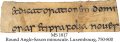
MS in Latin on vellum, Echternach, Luxembourg, 2nd half
8th c. or ca. 800, 1 fragment, 2,0x9,2 cm, single column, (2x8 cm
remaining), 2 lines remaining in round Anglo-Saxon minuscule by a Northumbrian
scribe.
Context: "The present MS likely belongs to one of the main texts of early medieval medical receptaria, Gariopontus or Petrocellus.
|
 |
| |
|
MSS 1816-1832 comprises the entire palaeography collection of the palaeographer Prof. Dr. Bernhard Bischoff (1906-1993). 65 ff. and fragments spanning 800-1600, and 40 uncatalogued early printed ff. and fragments.
Provenance: 1. Benedictine Monastery of St. Willibrord, Echternach,
Luxembourg (ca. 800-); 2. Stephan Beissel, Jesuit scholar (-1915); 3. Robert
Wölfle, München (-1958); 4. Bernhard Bischoff, München (1958-1993); 5. Robert
Wölfle, München (1993-1994); 6. Bernard Rosenthal, Berkeley, California.
Commentary: Written by a Northumbrian scribe according to Michelle Brown. According to Lowe, the E is distinctive for the Monastery of St. Wilibrord at Echternach.
For further insular scribes or insular influence in continental scriptoria:
See also MS 110,
Matthew, France, mid 9th c.
See also MS 102,
Bede, Germany, ca. 900
See also MS 1679,
Marcellus (PS), Bobbio, Italy, 10th c.
|
top
Irish Minuscule
| MS 1731 |
|
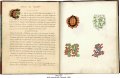
- IRISH ALPHABET OF ILLUMINATED INITIALS, COPIED FROM THE BOOK OF
LISMORE
- DUBLIN ANNALS OF INISFALLEN, COVERING THE HISTORY OF IRELAND, WITH A
SPECIAL REFERENCE TO MUNSTER, THOMOND AND THE O'BRIEN FAMILY FROM 250 -
1320
|
MS in Irish Gaelic (texts 1-2) and English (text 2, 2 pp. translation) on
paper, Ireland, 1836, 62 ff. (complete), 22x18 cm, single column, (19x14 cm)
26 lines in a fine Irish minuscule, 1 4-line initial with knotwork decorations
in green, orange and black, signed by Peadar O'Longain (text 2), 18 initials,
mostly ca. 5x4 cm, with knotwork decorations in green, orange, blue, yellow,
lillac and black, signed by Pol O'Longain (text 1).
Binding: Cork, Ireland, ca. 1836, half calf gilt on marbled boards, sewn on 3 cords, by Barry Drew.
Context: MSS 1731 - 1734 are all written by Peadar and/or Pol O'Longain, and have the same provenance.
|
 |
|
Provenance: 1. Library of the Christian Brothers, Marino, Dublin (-1990); 2. Hamilton, Osborne & King sale 1.5.1990:141; 3. G. MacAmhlaigh (1990-1993); 4. Eamonn De Búrca, Dublin.
Commentary: Text 1: Colophon: "From an ancient vellum book (Book of Lismore), written about the year 1139 by Aongus O'Cealla for Fineen McCarthy, and which was found in the castle of Lismore in the year 1816. Pol O'Longain copied these letters".
Text 2: Mainly unpublished, only a few extracts have been printed. The original compilation of the text was made in Paris in 1765 by John O'Brien, Bishop of Cloyne and Rev. John O'Mulconry and is now Oxford, Bodleian Rawl. B.503.
The O'Longain family were the chief representatives of the scribal tradition in the 18th and 19th c. Ireland. About 60 MSS each are attributed to the twins Peadar and Pol, and they collaborated on at least 40 more. |
top
Runes
| MS 1697 |
|
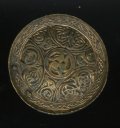
| RUNIC INCANTATION FORMULA: RAM IKA, KLA? IKA, OR R AMIKA
AKLA?I KAK |
 |
MS in Old Danish on silver, Denmark, 10th c., 1 strip, 7,8x0,3
cm, (7,1x0,3 cm), 1 long line in fine upright runes of the younger futhark.
Provenance: 1. Private Collector, Denmark; 2. David Miller, Hertfordshire (20th c.); 3. Nicholas Wright Collection, London (-1993).
Commentary: The meaning of the inscription is less than clear. The runic letter (eth) is here represented in a form (an X between 2 vertical strokes) not generally found in the Danish futhark. It occurs in the common Germanic futhark. Any writing in Old Danish is of great rarity. |
top
| MS 1576 |
 |
| CALENDAR WITH WEEKDAYS, FEASTDAYS, INCLUDING THE 2 ST. OLAV
AXES |
MS in Norwegian on walrus bone or reindeer horn, Norway, ca.
15th c., 6 ff., 3x14 cm, single column, (2x14 cm), 1 line in runes
of the younger futhark, 93 feastday symbols in a rather early primitive stage,
including the 2 St. Olav axes.
Binding: Norway, ca. 15th c., walrus bone or reindeer horn covers, fastened with 2 leather straps through holes.
Provenance: 1. Pitt-Rivers Museum, Farnham, Surrey (-1992); 2. Sam Fogg Rare Books Ltd., London.
Commentary: The 2 St. Olav axes, 29 July and 3 August, represent the most conclusive evidence of Norwegian origin. Calendars in bookform on bone are of the utmost rarity. This is the only specimen in private hands.
Runes are normally used for weekdays and golden numbers in Swedish calendars. In Norway they occur very rarely. |
|
Exhibited: "Preservation for access: Originals and copies". On the occasion of the 1st International Memory of the World Conference, organized by the Norwegian Commission for UNESCO and the National Library of Norway, at the Astrup Fearnley Museum of Modern Art, Oslo, 3 June - 14 July 1996. "The St. Romuald Psalter" is still in the Sacristry at the Monastery of San Salvatore, Camaldoli, 1 f. in Dillingen-an-der-Donau: Studienbibliothek, Fragm. 25. MSS owned by saints: MSS 260/36, 620, 639, 1000 and 1751. |
See also MS
1577, Calendar, Sweden, ca. 1500 |
 |
See also MS
1568, Calendar, Sweden, 1540 |
| |
| |
top
| MS 1570 |
 |
| SAGA OF ERLING SKAKKE KING OF NORWAY 1115 - 1179 |
MS in Norwegian on horn, Trøndelag, Norway, 17th c., 1 gunpowder horn, 25x8
cm, 9 lines in runes of the younger futhark, naming the participants in 9
drawings of battle scenes, the last illustrating the battle at Kalvskinnet,
where King Erling Skakke fell in 1179. The lid and finial of the horn carved
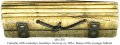
with heads of seals and strapwork decoration.
Provenance: P1. Birgit Buxam (19th c.); 2. Bjørn Smith Collection, Oslo.
Commentary: Copied from scenes in Snorre Sturlason's Håkon Herdebrei's Saga and Magnus Erlingsson's saga, which also includes the main parts of Erling Skakke's saga.
Any MS record of Norse sagas are of legendary rarity, even this late. This copy is written in runes and illustrated as well.
While the other national scripts derive from Roman cursive and half uncial, the runes origin from Roman capitals with influence from Greek and Phoenician. Most of the national scripts were extinct in the 9th c. following the Carolingian reform. The runes, however, lasted until the 18th c. and in ownership inscriptions and magic, they are still in use in Scandinavia, Germany and England. |
|
See also MS
2222/3, Calendar, Norway, 1647
See also MS
2222/2, Calendar, Norway, 17th c.
See also MS
592/1, Calendar, France, ca. 1800 |
top
>> CAROLINGIAN MINUSCULE