top
top
| MS 3178 | |
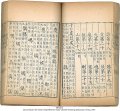
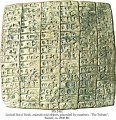
| LEXICAL SERIES "EA A NÂQU", TABLET 7, GIVING FIRST THE SUMERIAN PRONUNCIATION OF A SIGN, THEN THE SUMERIAN SIGN ITSELF, AND THEN THE BABYLONIAN TRANSLATION OF IT | |
MS in Neo Sumerian and Babylonian on clay, Babylonia, 1400-1100 BC, 1 tablet, 24,3x16,5x4,0 cm, 2+2 columns, 213 lines of originally ca. 260 lines, in cuneiform script. Context: Another tablet from "ea A nâqu" is MS 1811. The lexical series "ea A nâqu" consists of 8 tablets. From tablet 7 only 98 lines have so far been known of a total of ca. 260 lines. With the present tablet nearly all of the 260 lines can be restored. Commentary: This series and the series "Aa A nâqu" of 42 tablets are the basic tool and the foundation for reading and understanding the Sumerian and Babylonian languages. The present tablet fills a major gap in that knowledge. This is one of a very few witnesses from the Middle Babylonian period. See also MS 189, School Text or Dictionary, explaining verbs of motion. Egypt, 1st c. BC See also MS 1816 Isidorus Hispalensis: Etymologiarum sive originum, lib. XI, ii:33-37. Germany, ca. 800 Published: Miguel Civil: The Lexical Texts in the Schøyen Collection, Cornell University Studies in Assyriology and Sumerology, vol. 12, Manuscripts in the Schøyen Collection, Cuneiform texts V. CDL Press, Bethesda, MD, 2010, text 1.1.2, pp. 8-19. |
![]() |
top
top
| MS 2195 | |
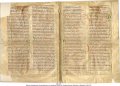
| TANHUM BEN JOSEPH YERUSHALMI: THE ADEQUATE GUIDE, AN ALPHABETICAL CONCORDANCE TO THE MISHNEH TORAH OF MAIMONIDES | |
MS in Hebrew and Judaeo-Arabic on paper, Egypt, 13th c., 38 ff., 20x13 cm,
single column, (14x9 cm), 18 lines in an oriental rabbinic Hebrew cursive
script. Binding: England, 1900-1940, dark red morocco gilt, sewn on 5 cords. Context: Another MS of the same author and Maimonides is MS 1862. Provenance: 1. The Cairo Genizah, Fustât, Egypt (-ca. 1896); 2. David Solomon Sassoon's Library, Hertfordshire, MS.410 (ca. 1921-1942); 3. David Solomon Sassoon's trustees (1942-1994); 4. Sotheby's 21.6.1994:86 (5th Sassoon sale); 5. Sotheby's 18.6.1996:42. |
![]() |
Commentary: This MS is contemporary with the author, Tanhum ben Joseph Yerushalmi (ca. 1220-1291). Second to the caves of the Dead Sea Scrolls, the great Genizah in Cairo is the most significant and evocative source for any fragments of early Hebrew MSS. The Genizah was fully unearthed from 1896. Probably no Egyptian finds, except that of Tutankhamon in 1922, has ever excited the public imagination so much at the time of the discovery. No single source have added so much to our knowledge of early Jewish culture. Literature: D.S. Sassoon: Ohel Dawid, Descriptive Catalogue of the Hebrew and Samaritan Manuscripts in the Sassoon Library, London 1932, I, p. 492. Exhibited: XVI Congress of the International Organization for the study of the Old Testament. Faculty of Law Library, University of Oslo, 29 July - 7 August 1998. See also MS 2547, Encyclopaedia of the writing styles and formats. China, 1307-1367. 13 vols. |
|
top
| MS 1000 | |
| THE PLINY OF SAINT JAMES IN THE MARCH GAIUS PLINIUS SECUNDUS MAIOR: HISTORIA NATURALIS BOOKS 1-13, 19-37 |
|
MS in Latin on vellum, Italy, ca. 1400, 2 vols., 105+177 ff. (complete), vol. 1 (Books 1-13): 35x25 cm, single column, (25x16 cm), 44-59 lines in Italian cursive by several scribes, vol. 2 (Books 19-37): 37x25 cm, 2 columns, (25x16 cm), 43-45 lines in a clear Gothic book script, several large fine decorated initials in blue with red penwork and marginal extenders, numerous smaller initials in red or blue with marginal scrollwork, contemporary annotations by Saint Giacomo della Marca, including autograph notes at the end of each volume, signed by Saint Giacomo. Binding: England, 19th c., blindtooled brown diced russia, sewn on 5 bands. Context: MSS owned by saints: MSS 260/36, 620, 639, 1000 and 1751. Provenance: 1. Saint Giacomo della Marca, Monteprandone in the March of Ancona (1394-1476); 2. Franciscan Convent of Santa Maria delle Grazie, Monteprandone in the March of Ancona (15th-early 19th c.); 3. Thomas Payne, London (1823); 4. Sir Thomas Phillipps, Cheltenham, Ph 4196-97 (1823-1872); 5. Harrison D. Horblit, Ridgefield, Connecticut (d. 1988); 6. H.P. Kraus cat. 155(1980):14, and cat. 186(1991):126. |
![]() |
Commentary: From a Saint's library, with his autograph annotations and signatures. On the endleaves of both volumes, the Franciscan Saint Giacomo della Marca (St. James in the March) writes that he bought both volumes together for 14 1/2 gold ducats for the convent, and ends with: "ego frater Jacobus de eodem loco". He was observantine friar, a pupil of St. Bernardinus of Siena, mendicant preacher, penitent, scribe and inquisitor. Pliny (23-79) was a man so intensely interested in the natural world that he was killed while trying to observe at close quarter the eruption of Vesuvius, that buried Pompeii, Herculaneum and Stabia. Pliny the younger claimed that his uncle's book in 37 volumes was "a learned and comprehensive work as full of variety as nature itself". It includes more than 20,000 facts derived from over 2000 earlier texts, which makes it much more than the title implies. It is an encyclopaedia of all the useful knowledge of the ancient world, covering astronomy, geography, zoology, botany, agriculture, medicine, magic, mining and minerals, coinage, painting, sculpture, papyrus making, scribal techniques, architecture, anthropology, philosophy, history, and more. |
|
top
top
top