logo homecontents

4.3.7. East European book scripts

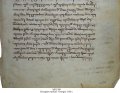
Cyrillic uncial

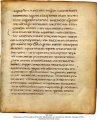
Cyrillic half uncial

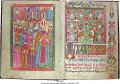
Cyrillic semi vjaz

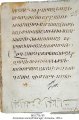
Armenian uncial, Erkat'Agir

Armenian minuscule, Bolorgir

Georgian Asomatavruli

Georgian Khutsuri

Georgian Nuskuri

Glagolitic book script


Cyrillic uncial


See MS 2623, Old believer Apocalypse. Russia, 1812


Cyrillic half uncial

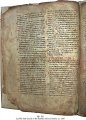
MS 702

OCTOECHOS: APOSTICHA FOR MONDAY OF THE 4TH TONE TO THE SESSIONAL HYMNS FOR FRIDAY OF THE 4TH TONE, AND 2ND ODE OF THE CANON FOR SUNDAY OF THE 5TH TONE TO THE HEIRMOS FOR THE 7TH ODE OF THE CANON FOR SUNDAY OF THE 6TH TONE

ms702

MS in Serbian Church Slavonic on vellum, Serbia, ca. 1300, 8 ff., 30x23 cm, 2 columns, (23x16 cm), 44 lines in a small Cyrillic half-uncial of the Rashka school, 2-line initials in red throughout.

Binding: London, England, 1990, half leather over oak boards, sewn on 4 cords, by Ruth Kirkby.

Context: For a 14th c. Serbian octoechos, see MS 261.

Provenance: 1. Sam Fogg Rare Books Ltd., London.

Commentary: One of the earliest Serbian MSS known, cf. MS 261.

See also MS 1750, Gospels, Moldavia, ca. 1450

See also MS 708, The Shepochkin Apostol, Russia, ca. 1500


Cyrillic semi vjaz

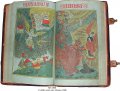
MS 1868

1. STRASTI CHRISTOVY, INCLUDING JOHN THE BAPTIST'S MEETING WITH THE PATRIARCHS AND PROPHETS IN HELL, A CYCLE OF PICTURES
2. VISION OF GREGORY, AFTER BASIL THE YOUNGER, WITH AN ANECDOTE FROM THE CYCLE OF SYNODIK
3. BIBLE: REVELATION, CHAPTERS OF THE BIBLICAL TEXT REPRODUCED WITH AN INTERPOLATED INTERPRETATION (TOLKOVANIE)
ms1868 ms 1868 - 2 ms 1868 - 3

MS in Russian Church Slavonic on blue paper, Russia, 1806, 117 ff. (complete), 34x20 cm, single column, (29x16 cm), 30 lines in Cyrillic half-uncial and semi-vjaz by several scribes, some titles in red, 78 full-page coloured miniatures in colour wash over pen and ink drawing, in plain yellow frames.

Binding: Russia, ca. 1806, blindstamped brown leather over bevelled boards, sewn on 4 cords, brass and leather clasps, the title "Knigaglezha" (Picture book) in semi-vjaz at head and foot of front cover, "Strasti Xristovy" in uncials on spine.

Provenance: 1. Private collection, N4058 and N13/40; 2. Sam Fogg Rare Books Ltd., London.

Commentary: The pictures are of some of the most striking Christian imagery, and also revealing the influence of the cycle of engravings by Master Koren (1696).

The pictures in the Revelation (text 3) are showing the influence of the 1534 edition of the Luther Bible in Russian art.


Armenian uncial, Erkat'Agir

See also MS 575, Codex armenicus rescriptus, Egypt, 6th c.

MS 1776/05

1. ZAMAGIRK, PART OF THE ARMENIAN ORTHODOX PRAYERBOOK, WITH TEXTS FROM JOHN AND MATTHEW
2.THOUSAND AND ONE NIGHTS: THE FIFTH PART OF THE TWISTINGS/TURNINGS?
ms1776/05

MS in Armenian and Arabic (text 2) on vellum, Armenia, 12th c., 1 partial f., 18x27 cm, 2 columns, (13x23 cm remaining, column width 10 cm), 10 lines remaining in a large sloping Armenian uncial (Erkat'agir); text 2: Palestine/Damascus, 13th c., 4 lines in Arabic naskhi script.

Context: Only 6 MSS of 12th c. crusader books have hitherto been identified: B.L. Egerton MS.1139, Cambridge, Fitzwilliam Museum McClean MS.49 (fragment), B.N. mss.lat.9396 and 12056, and Vatican cod.Vat.lat.5974. All are luxury books, and rescued to the West in the face of the advancing armies of the Mameluks before 2nd October 1187.

Provenance: 1. Church of the Holy Sepulchre, Latin Kingdom of Jerusalem (until 1187); 2. Saracens, Palestine/Damascus (1187-); 3. Private owner, Damascus, Syria (20th c.); 4. Sotheby's 6.12.1993:3e.

Commentary: The importance of the Crusades in the history of medieval Europe can hardly be over-estimated. The liberation of the Holy places was looked upon as God's own work. Antioch fell to the Franks in 1098, Jerusalem in July 1099. In 1100, Baldwin, count of Edessa, was crowned king of Jerusalem. By about 1131 Jerusalem stood supreme as the Christian capital on the very edge of the world, principally a French and Genoese kingdom. The Church of the Holy Sepulchre was its cathedral, and followed from 1114, the western Latin liturgy according to the rule of St. Augustine. The Church must have been the leading scriptorium during this period. Jerusalem fell to Saladin on 2nd October 1187, the sacristy of the Church of the Holy Sepulchre was looted and destroyed, and its libraries were destroyed. The leaves of MS 1776 more or less double our knowledge of crusader MSS, and were perhaps the first Latin books ever seen by the Saracens, who, instead of destroying them all, kept some for their vellum.
They used the vellum for that most quintessential of Middle Eastern romances and fairy tales, Thousand and One Nights, also known as the Tales of the Arabian nights. They origin from India, Iran, Iraq, Egypt and Turkey, and the tales of Aladdin, Ali Baba and Sindbad the Sailor have almost become part of Western folklore. The earliest known reference to the Thousand and One Nights is a 9th c. fragment, while the present MS is from the 12th c. collection where Egyptian fairy tales were included for the first time.


Armenian minuscule, Bolorgir

MS 2082

MISSAL, FOR THE USE OF ARCHBISHOP MOUSES

ms 2082 - 2 ms2082

MS in Armenian on paper, Tbilisi(?), Georgia, 1721, 30 ff. (complete), 24x18 cm, 2 columns, (20x14 cm), 21 lines in a handsome bolorgir script by the priest Avedis, each column within a gold and coloured frame, small initials in red and blue, 21 large illuminated initials formed of animals, birds, fish, people, angels, etc. in colours and gold, 22 illuminated borders of naturalistic bunches of flowers, 10 column-width miniatures, a half-page miniature of the last supper, a full-page facing title-leaf with flowers, birds and animals, and a full-page miniature showing the bishop with 8 priests within a church.

Binding: Armenia, 19th c., marbled boards, leather spine, sewn on 3 cords.

Provenance: 1. Archbishop Mouses, Tbilisi? (1721); 2. Tavit, Tbilisi (until 1771); 3. Krikov son of Daniel, Tbilisi and Baku (1796); 4. Church of St. Mary, Baku (1796-); 5. Sotheby's 5.12.1995:25.

Commentary: Missals in Armenian are extremely unusual.


Georgian Asomatavruli

MS 1600

ATHANASIUS OF ALEXANDRIA (PSEUDO): QUASTIONES AD ANTIOCHUM DUCEM 94 - 101

ms1600

MS in Georgian on vellum, Georgia, 10th c., 2 ff., 23x20 cm, single column, (18x14 cm), 22 lines in a very fine asomatavruli book script.

Context: 2 ff. of a gathering of 6 ff. containing the questions 94-101, probably all that is surviving of a high quality MS. However, it is very closely related to Leipzig University Library V. 1096 Part 3, containing Questions 109, 110, and 115.

Provenance: Sam Fogg Rare Books Ltd., London.

Commentary: Georgian MSS extant worldwide number about 10,000 of which the great majority are late. 8700 of these are in the Georgian locations Tbiblisi and Kutaisi. Further there are 500 in St. Petersburg, 161 in the Greek patriarchate in Jerusalem, 86 in Monastery of St. Catherine, Mt. Sinai, 22 in Erevan, and 9 in Moscow. Elsewhere in the world only small stray collections are found. They are virtually unknown in private hands, nevertheless there are 5 Georgian MSS in The Schøyen Collection: MSS 35, 37, 1598-1600.


Georgian Khutsuri

MS 037

1. ST. CYRIL: CATACHESES BAPTISMALES, III, 5 - 6
2. PIMEN:TEACHINGS (THE SAYINGS OF THE HOLY CHURCH FATHER FROM SYRIA TEACHING IN EGYPT)

ms037

MS palimpsest on vellum, Mt. Sinai, Egypt. Text 1 (underlying text): in Christian Palestinian-Aramaic, 6th c., 1/2 f., 12x19 cm, originally 31x23 cm, 2 columns (12x18 cm, originally ca. 25x21 cm), 12 lines (originally 24 lines) in Christian Palestinian-Aramaic uncial. Text 2 (overlying text): in Georgian, 979, 1 f., 19x12 cm, originally 20x15 cm, single column, (17x12 cm), 25 lines in Khutsuri (Georgian ecclesiastical minuscule) by Ioane Zosime.

Binding: Barking, Essex, 1990, green cloth gilt folding case, by Aquarius.

Context: Another 35 ff. = MS 35, and 1 1/2 f. (3 ff.) = MS 36 are possibly from the original codex of 6th c. 16 1/2 ff. (33 ff.), also from the same codex, in St. Petersburg, The National Library of Russia (mostly St. Cyril: Catacheses), brought to St. Petersburg from Mt. Sinai in 1859 together with Codex Sinaiticus by Konstantin von Tischendorf.

Further MSS from Mt. Sinai see MSS 35, 36, 571-585, 613, and 2530

Provenance: 1. Monastery of St. Catherine, Mt. Sinai (6th-19th c.); 2. Friedrich Grote, Germany (ca. 1900); 3. Private collection, Berlin (1929); 4. D. MacLaren; 5. Sotheby's 12.4.1954:302; 6. Dr. Otto Fisher, Detroit; 7. H.P. Kraus, "Monumenta Codicum Manuscriptorum" cat. (1974):2; 8. H.P. Kraus cat. 165(1983):28.

Commentary: Underlying text: The script is together with the nearly identical one in "Codex Climachi Rescriptus", Mt. Sinai, mid 6th c., considered the finest and earliest specimen of Christian Palestinian-Aramaic uncial extant. Apart from the 3 MSS in The Schøyen Collection, only the Vatican, St. Petersburg and Mt. Sinai libraries have MSS in this language and script, and even the Mt. Sinai library has only 3, all from 11th c. Text 2 (overlying text) is unique, cf. MS 35/2.

Published: Underlying text: Alain Desreumaux: Codex sinaiticus Zosimi rescriptus; Description codicoligique de feuillets araméens melkites des manuscrits Schøyen 35, 36 et 37. In: Histoire du Texte Biblique 3. Lausanne, Éditions du Zèbre, 1997.


Georgian Nuskuri

MS 1599

HOMILY ABOUT A SINNER ON THE POINT OF DEATH, PLEADING WITH THE ANGELS WHO HAVE COME TO TAKE HIM BEFORE THE JUDGEMENT

ms1599

MS in Georgian on vellum, Georgia, 11th c., 1 f., 25x19 cm, single column, (19x13 cm), 25 lines in a fine nuskuri book script.

Provenance: Sam Fogg Rare Books Ltd., London.

Commentary: Georgian MSS extant world-wide number about 10,000 of which the great majority are late. 8700 of these are in the Georgian locations Tbiblisi and Kutaisi. Further there are 500 in St. Petersburg, 161 in the Greek patriarchate in Jerusalem, 86 in Monastery of St. Catherine, Mt. Sinai, 22 in Erevan, and 9 in Moscow. Elsewhere in the world only small stray collections are found. They are virtually unknown in private hands, nevertheless there are 5 Georgian MSS in The Schøyen Collection: MSS 35, 37, 1598-1600.


Glagolitic book script

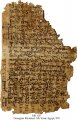
MS 1391

STATUTES OR RULES OF ASSOCIATION OF A LAY FRATERNITY, CH. 12 - 16, LISTING CITIES IN NORTHERN DALMATIA AND OFFSHORE ISLANDS IN THE ADRIATIC WHERE MEMBERS OF THE FRATERNITY MIGHT FALL ILL

ms1391

MS in Croatian on vellum, Island of Krk, Croatia, early 15th c., 2 ff., 29x21 cm, 2 columns, (19x13 cm), 26 lines in Glagolitic book script, headings in red, 2 7-line and 4 half-page illuminated initials in strapwork and leafy design in red and black with yellow wash infill.
Provenance: 1. Lay Fraternity at Krk, Croatia (15th c.-); 2. Predrag Milovanovich, Beograd, Serbia (20th c.); 3. I. Pozarich, Zagreb, Croatia (-1991); 4. Jeremy Griffiths, Oxford.

Commentary: The Adriatic island of Krk is famous for its long Glagolitic tradition and numerous medieval fraternities.

Glagolitic was a specialized script, used in Croatia and still retained in printed Catholic service-books of the Slavonic rite in Dalmatia. Examples of Glagolitic script are extremely rare. The earliest surviving MS dates from 2nd half of 14th c, but most surviving MS are from 16th c. Statutes like the present MS are not known before 15th c.


Next collection