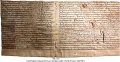
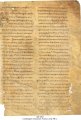
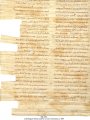
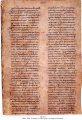
- MS 617 Germany, ca. 800
- MS 1761 Germany, ca. 800
- MS 078 Germany, 825-850
- MS 102 Germany, ca. 900
- MS 1762 France, early 9th c.
- MS 110 France, mid 9th c.
- MS 074 Italy, 2nd half 9th c.
- MS 1679 Italy, 10th c.
- MS 1277 Italy, ca. 1125-1130
- MS 1542 England, 1000-1050
- MS 2366 England, mid 11th c.
- MS 076 England(?), ca. 1100
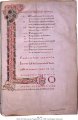
BIBLE: TOBIT 2:13 - 4:19
![]()
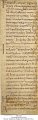
MS in Latin on vellum, Lorsch, Germany, ca. 800, 1 f., 41x29 cm, 2 columns, (38x23 cm), 45 lines in a bold expert early Lorsch Carolingian minuscule of the "older Lorsch style".
Context: The script is reminiscent of Charlemagne's court school scribe Godescalc, similar to, if not identical with, Vatican pal. lat. 170.
Provenance: 1. Benedictine Abbey of Lorsch; 2. Hauswedell Cat. 212(1976):491; 3. Bernard Rosenthal Collection, San Francisco, I/240; 4.Bernard Quaritch Ltd., Cat. 1147(1991):1.
Commentary: Probably the only survival of an early Lorsch pandect.
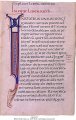
BIBLE: LEVITICUS 14:39 - 42; 14:47 - 56; 14:53 - 15:2; 15:5 - 8; 16:25 - 27; 16:31 - 33; 17:3 - 11; 21:6 - 23:7
![]()
MS in Latin on vellum, Kochel, Germany, ca. 800, 4 ff., 31x22 cm, 2 columns, (25x18 cm), 29 lines in Carolingian minuscule by a nun.
Context: Other codices from 750 to around 800, written by 8 nuns at Kochel, are München: Bayerische Staatsbibliothek, Clm 4549 group.
Provenance: 1. Benedictine Nunnery, Kochel, Germany (ca. 800-955); 2. Bernard Quaritch Ltd., London.
Commentary: Kochel is a small and insufficiently known or appreciated scriptorium of nuns, whose community was associated with Benedictbeuren. Like Pfalzel near Trier and several French nunneries, it was a common resting place for English nuns on their pilgrimage to Roma. It was founded in 750 and destroyed by the Hungarians in 955.
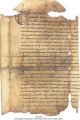
EUGIPPIUS: EXCERPTA EX OPERIBUS S. AUGUSTINI, CH. 2 - 4
![]()
MS in Latin on vellum, Fulda, Germany, 825-850, 1 f., 31x23 cm, single column, (26x20 cm), 35 lines in a strikingly even, heavy round Carolingian minuscule, reminiscent of 6th c. half-uncial, suggesting an ancient exemplar, headings in a fine half-uncial.
Provenance: 1. Benedictine Abbey of Fulda, Germany (ca. 840-); 2. Collection von Bülow(?); 3. Internationaal Antiquariaat Menno Hertzberger & Co., Amsterdam 22.6.1966:1120; 4. Ludwig Rosenthal, Hilversum, Netherlands; 5. Bernard Rosenthal Collection, San Francisco, I/202 (until 1987); 6. Bernard Quaritch Ltd., Cat. 1088(1988):10.
Commentary: The text survives in 2 MSS of 7th c. and 6 MSS of 8th and 9th c. only, all in public libraries. The present leaf is a valuable witness to the production of the key texts, useful to such an important monastery as Fulda in the first part of 9th c. Our information about Fulda's library is extremely patchy in this period, and it thus fills a considerable gap in our knowledge.
Published: Fuldische Handschriften aus Hessen, mit weiteren Leihgaben aus Basel, Oslo, dem Vatikan und Wolfenbüttel. Hartmut Broszinski und Sirka Heyne: Katalog zur Ausstellung anlässlich des Jubiläums "1250 Jahre Fulda" Hessische Landesbibliothek Fulda, 19. April bis 31 Mai 1994, Fulda, Hessische Landesbibliothek, 1994, no. 20, p.60.
Klaus Gugel: Aus fuldischen Handschriften. Ein bisher unbekanntes Fragment aus einer Fuldaer Handschrift des früher 9. Jahrhunderts; in Fuldaer Geschichtsblätter, Jahrgang 67, 1991, pp. 65-79.
Exhibited: "1250 Jahre Fulda" Hessische Landesbibliothek Fulda, 19. April bis 31 Mai 1994, Fulda, Hessische Landesbibliothek, 1994, no. 20, p.60.
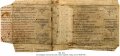
BEDE: HISTORIA ECCLESIASTICA, INCIPIT & CHAPTER 1
![]()
MS in Latin on vellum, Germany, ca. 900, 1 f., 31x21 cm, originally ca. 38x33 cm, 2 columns, (30x20 cm remaining), 31-32 lines (originally 33 lines), in a late uneven Carolingian minuscule with insular tendencies, 4 lines of opening text in red rustic capitals, 5-line initial "B" in an entwined ropework and leafy design with red, blue, and yellow wash (the colours perhaps added 11th c.).
Provenance: 1. Bernard Quaritch Ltd., Cat. 1088(1988):3.
Commentary: Of the 159 extant MSS and fragments recorded, 6 are of the 8th c., and 11 are of the 9th or 9th/10th c. Probably written by an insular scribe in a Germano-Saxon scriptorium, or copied after an insular exemplar.
HOMILY ON ACTS
MS in Latin on vellum, St. Martin's Tour, France, early 9th c., 1 f., ca. 30x21 cm, 2 columns, (27x18 cm), 33 lines in Carolingian minuscule, 5-line decorated initial H.
Provenance: 1. Benedictine Abbey of St. Martin, Tour (early 9th c. -); 2. Bernard Quaritch Ltd., London.
BIBLE: MATTHEW 4:18 - 5:37, COMMENTARY
![]()
MS in Latin on vellum, North France, mid 9th c., 2 partial ff., 15x18 cm, originally 22x22 cm, single column, (13x17 cm, originally 17x18 cm), 25 lines (originally 26-29 lines) in a small, compact Carolingian minuscule by an Anglo-Saxon or Irish scribe.
Context: 2 partial ff., forming the outer bifolium of Tokyo, The International Christian University, MS 110.
Provenance: 1. Philip Bliss, Oxford (1787-1857); 2. Sotheby's 21.8.1858:119; 3. Sir Thomas Phillipps, Cheltenham, Ph 15659 (1858-1872); 4. Katharine, John, Thomas & Alan Fenwick, Cheltenham, (1872-1911); 5. Sotheby's 24.4.1911:390(or 391); 6. Edmund Hunt Dring, London (1911-1928); 7. Edmund Maxwell Dring, London (1928-1984); 8. Quaritch Cat. 1036(1984):78; 9. Bruce Ferrini Cat. 2(1989):2.
Commentary: From a previously unidentified and unrecorded Carolingian commentary on Matthew, written by an insular scribe in a Franco-Saxon scriptorium under the influence of the scriptorium of St. Martin's Tour.
BIBLE: PSALMS 45:6 - 47:15, WITH INTRODUCTIONS TO PSALMS 46, 47, 48, GLOSSED
![]()
MS in Latin on vellum, Milano area, Italy, 2nd half 9th c., 2 partial ff. (upper part of a bifolium), 23x19 cm, originally 36x26 cm, single column, (23?x20 cm), 19 lines (originally 28 lines), gloss in one margin only, in a fine clear, firm Carolingian minuscule, title in red half-uncial with 5 lines in red rustic capitals, the gloss in a slightly less formal and smaller script by the same scribe, set out to form elegant triangular shapes.
Context: Another fragment from the same MS in Dillingen, Kreis- und Studien-Bibliothek (Fragm. V), containing illustrations. The parent MS has been of high quality and elegance in term of script, layout and design.
Provenance: 1. Mr. Neuss, München area; 2. Robert Wölfle, München (until 1979); 3. Bernard Rosenthal Collection, San Francisco, I/244 (1979-1987); 4. Bernard Quaritch Ltd., Cat. 1088(1988):56.
Commentary: The Carolingian gloss is hitherto unknown and the two fragments are the only witnesses to it. The layout was specifically designed to accommodate the gloss.
Published: R. McKitterick: Carolingian Book Production; The Library, 6th series, vol., no. 1, Oxford 1990, pp. 23-25.
MARCELLUS (PS): PASSIO SANCTORUM PETRI ET PAULI
![]()
MS in Latin on vellum, Bobbio, Italy, 10th c., 1 f., 29x20 cm, single column, (24x16 cm), 27 lines in a very distinctive forward-sloping Carolingian minuscule with insular letter forms, large decorated initial of the opening page of the text in dark brown, elaborate scrolling leafy and petal design, infilled with dark brown and red wash in insular style.
Provenance: 1. Benedictine Abbey of SS. Peter and Paul, Bobbio, Italy (10th c.-); 2. Sotheby's 22.6.1993:3.
Commentary: The monastery of Bobbio was one of the most important of the early Irish communities, founded by St. Columban in 612, and finally suppressed ca. 1789. The 10th c. library catalogue of Bobbio includes a single volume called "Libros de passione apostolorum Petri & Pauli I". It is very possible that this is a contemporary record of the present MS.
- BIBLE: JUDGES 21:11 - 19
- BIBLE: RUTH 1:1 - 6
![]()
MS in Latin on vellum, Roma or Umbria-Roman region, Italy, ca. 1125-1130, 1 partial f., 24x22 cm, originally ca. 55x40 cm, 1 of 2 columns, (column width 11 cm), 26 lines (originally ca. 50 lines) in a late rounded Italian Carolingian minuscule of very high quality, 4 lines of the text and all initials in an expert uncial, 23-line hollow shafted transitional geometrical initial "I", 20x4 cm, of an interlaced design in a strong bright blue, the shaft filled with four-petalled rosettes in red and blue, knotwork at top and ending in a feather-like ornament in black red and green, expertly done by an unidentified master.
Provenance: 1. Rodrigues Collection; 2. Paul Graupe Antiquariat, Berlin, Auction 76, 12.12.1927:26; 3. Georg Swarzenski (1927-1974); 4. H.P. Kraus, New York (1974-1975); 5. Professor H. Bober (1975-); 6. J. Bober (-1989); 7. Bruce Ferrini collection, Akron, Ohio (1989-1991).
Commentary: The outer lower quarter of a leaf from an Atlante (Giant) Bible. "The beauty of this initial lies in its simplicity, and clarity of detail, features that are all the more enhanced by its remarkable state of preservation", Usha M. Subrahmanyam: Twelfth century initial styles in Central Italy. Institute of Fine Arts, New York University, February 1983.
MISSAL: TEMPORAL FOR 17 - 18 FEBRUARY
![]()
MS in Latin on vellum, England, 1st half of 11th c., 1 partial f., 27x9 cm, originally 27xca.22 cm, 1 of 2 columns, (25x7 cm remaining, column width 8 cm), 32 lines in Carolingian minuscule, 5 lines in red uncials, 4 red 2- to 3-line capitals.
Provenance: 1. Peter Croft, England (1929-1979); 2. Dr. George Salt, Cambridge (1979-1991); 3. Sotheby's 17.12.1991:4.
Commentary: Very few liturgical MSS from the Anglo-Saxon period have survived.
AUGUSTINUS: DE FIDE, SPE ET CARITATE, PARTS OF CHAPTER 32, 7 AND 8
![]()
MS in Latin on vellum, England, mid 11th c., 2 partial ff., 10x15 cm remaining, single column, (8x13 cm), 13+9 lines in an expert calligraphic English Carolingian minuscule, with 6 lines of marginal notes.
Context: Pastedown in a copy of Aeschylus: Works (in Greek), Paris, A. Turnebus, 1552, Adams A264; in a slightly later Oxford binding of blindstamped calf.
Provenance: 1. Binder, Oxford (before 1641); 2. Private owner (1641); 3. G.H.R. Denham (1836); 4. G. Thielton (1844); 5. A. Faustini, Brooklyn, New York (1925); 6. Bernard Quaritch Ltd., London.
Commentary: The script is an outstanding example of calligraphic beauty. For comparable hands see T.A.M. Bishop, English Caroline minuscule, 1971, nos. 26-28.
BEDE: DE TABERNACULO
MS in Latin on vellum, England(?), ca. 1100, 1 f., 27x18 cm, single column, (19x11 cm), 29 lines in a small round late Carolingian minuscule (recto), and a more spiky script (verso), incipit leaf with a large initial "L" extending the entire length of the text in red, green, brown and yellow, entwining leafy design with a knotted finial at top and a lion's head at bottom.
Context: Only 3 more Bede fragments with English provenance are known: 2 recorded by N. Ker, and MS 127 in The Schøyen Collection.
Provenance: 1. Bernard Quaritch Ltd., Cat. 1088(1988):4.
Commentary: The incipit leaf, hitherto unrecorded, clearly Norman in style.