<< top of current collection| 2 >>

<< previous page | next page >>


1: THE BIBLE

1.1 THE HEBREW & ARAMAIC BIBLE


1.2 THE GREEK NEW TESTAMENT & THE SEPTUAGINT


1.3 THE COPTIC BIBLE TRANSLATIONS


1.4 LATIN BIBLE TRANSATIONS


MS 046 Italy, 5th c.
See also MS 030, Italy, 6th c.
MS 020 Roma, 2nd half of 9th c. and 2nd half of 11th c.
MS 006/1 Belgium, ca. 1200
See also MS 692, England, 1220-1240
MS 262 Spain, ca. 1250
MS 115 France, 2nd half 13th c.
MS 015 England, 3rd quarter 13th c.
MS 661 Italy, ca. 1310
MS 1368 England 1320-1330

1.5 OTHER BIBLE TRANSLATIONS

1. The Bible

1.4. Latin Bible

MS 046 ms 046
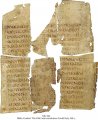
BIBLE: EZEKIEL 20:34 - 39; 20:43 - 47 IN THE OLD LATIN VERSION
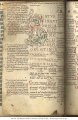
MS in Latin on vellum, North Italy, 5th c., 1 partial f., 17x15 cm, originally 28x26 cm, 2 columns (originally 3 columns), (13x12 cm, originally 17x19 cm), 18 lines (of 23 lines) in an expert uncial without word spacing and abbreviations except Nomina Sacra, liturgical marginalia in a very small quarter-uncial with many ligatures, also of 5th c.

Binding: Barking, Essex, 1988, red morocco gilt folding case by Aquarius.

Context: From the late Medieval binding of the Sacramentary, Reichenau, 9th c., Donaueschingen MS 191. Parts of 45 more ff. of the present MS survive, some only in offset: 2 ff. in Darmstadt, Landes- und Hochschulbibliothek, MSS 895 (offset) and 3140; 16 ff. in Fulda, Landesbibliothek, MSS Aa and 1a; 4 ff. in St. Paul in Carinthia; 20 ff. in Stuttgart, Landesbibliothek.

Provenance: 1. Benedictine Abbey of Reichenau, Konstanz, Germany (ca. 830-late 13th c.); 2. Konstanz Cathedral, Germany (late 13th c.-ca. 1800); 3. Joseph, Freiherr von Lassberg (1770-1855); 4. Prince Karl Egon III, Donaueschingen (1820-1892); 5. Fürstliche Fürstenbergische Hofbibliothek, Donaueschingen, B I, 3 (1892-1982), present owner Prince Joachim Egon Fürstenberg; 7. Sotheby's 21.6.1982:1; 8. Winsor T. Savery, Houston, Texas (Pax ex Innovatione Foundation, Vaduz, Liechtenstein); 9. acquired via Sotheby's/Quaritch.

Commentary: Oldest witness in Latin of Ezekiel 20, oldest European Latin leaf in private hands. "Vetus Latina" is the old Latin translations of the Bible that preceded the Vulgate. No complete MS is preserved. Only scattered fragments have survived, and all except this MS are in public collections. E.A. Lowe: "An expert uncial of the finest and oldest type." CLA VIII:1174.

Published: Ernst Würthwein: The Text of the Old Testament. London 1979/80, pp. 88-89, 200-201. Mentioned in: E.A. Lowe: Codices Latini Antiquiores, vol. VIII. Oxford 1959, p. 43, no. 1174.

Exhibited: NorFa - Nordic network in Qumran studies. Symposium in Oslo 3-5. June 2004.

See also MS 030, Bible: Matthew, Italy, 6th c.

back to top top
MS 020  

THE SANTA CECILIA BIBLE

  1. BIBLE: GENESIS 12:20 - RUTH WITH CAPITULA AND ONE ST. HIERONYMUS PROLOGUE
  2. ST. HIERONYMUS: CONTRA HELUIDIUM DE VIRGINITATE SANCTAE MARIAE
  3. ST. HIERONYMUS: AD EUSTOCHIUM FILIAM SANCTAE PAULAE DE VIRGINITATE SERVANDA
  4. BIBLE: 1 KINGS 8:20 - 22:53
  5. BIBLE: 2 KINGS 1:1 - 9:9
  6. BIBLE: JOB WITH 2 ST. HIERONYMUS PROLOGUES
  7. BIBLE: TOBIT WITH ST. HIERONYMUS PROLOGUE
  8. BIBLE: JUDITH WITH ST. HIERONYMUS PROLOGUE
  9. BIBLE: ESTHER WITH ST. HIERONYMUS PROLOGUE
  10. BIBLE: 1 EZRA WITH ST. HIERONYMUS PROLOGUE
  11. BIBLE: NEHEMIAH (2 EZRA)
  12. BIBLE: 1 & 2 MACCABEES WITH CAPITULA
  13. LECTIONS FOR THE FEAST OF ST. MARIA MAGDALENA
  14. BIBLE: PROVERBS 1:1 - 26:18 WITH ST. HIERONYMUS PROLOGUE
ms020
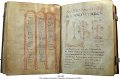
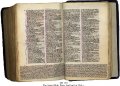
MS in Latin on vellum, Roma, Italy, vol. 1 (texts 1-3): 2nd half of 9th c., 228 ff. (-8), 33x24 cm, 2 columns (25x17 cm), 35 lines in a very fine Carolingian minuscule by 2 scribes, 7 large decorated initials in intertwined leafy and strapwork design. Vol. 2 (texts 4-14): 2nd half of 11th c., 290 ff. (-ca. 40), 37x28 cm, 2 columns (from 25x17 cm to 31x20 cm), 21-37 lines in a late Carolingian minuscule by 9 scribes, 12 very large decorated initials in various styles, but usually in very elaborate interlaced vinestem designs of Ottonian style. ms020

Binding: Italy, 19th c., brown quarter morocco gilt, sewn on 5 cords.

Context: Vols. 1 and 2 of a 4 vols. Bible. Vols. 3 and 4 are lost.

Provenance: 1. Benedictine Abbey of Santa Cecilia, Roma (9th-18th c.); 2. Cardinal Antonio Saverio Gentili, Roma (1681-1753); 3. Principe del Drago, Roma; 4. Marchese Campana (until 1860); 5. Sotheby's 20.6.1860:130; 6. Boone, London (1860-1862); 7. Guglielmo Libri (1803-1869), (1862); 8. Sotheby's 25.7.1862:70; 9. Edwin Tross (1862-); 10. Enoch T. Carson, Cincinnati, Ohio, Cat. 1880:764; 11. Hamilton Cole (until 1890); 12. Bangs & Co, New York 7.4.1890:30; 13. Alfred Tredway White (1890-1919); 14. The Brooklyn Museum, New York (1919-1987); 15. Sotheby's 23.6.1987:72. Deaccession May 2010.

Commentary: Vol. 1: Text is second only in accuracy to the Alcuin Bible pandect - the "Bible of San Paolo fuori le Mura", Roma, which might have been the exemplar. The only Carolingian Bible in private ownership.

Exhibited: Conference of European National Librarians, Oslo. Sept. 1994.

ms020vol1 ms020vol2
back to top top
MS 006/1   MS

THE GERAARDSBERGEN BIBLE

  1. BIBLE: 1 KINGS - 2 MACCABEES, EXCLUDING THE PSALMS AND THE PROPHETS, WITH CAPITULA AND ST. HIERONYMUS PROLOGUES
  2. BIBLE: PROPHETS, ISAIAH 5:2 - MALACHI 3:6, WITH ST. HIERONYMUS PROLOGUES
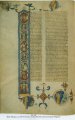
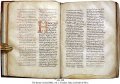
MS in Latin on vellum, Geraardsbergen, Cambrai, Belgium, ca. 1200, 2 vols., 201 ff. (complete) + 121 ff. (-79), 43x29 cm, 46x31 cm, 2 columns (33x21 cm), 41 lines in a large late Romanesque formal book script, 4 lines in display half uncials in red and green, 5 lines in display initials in blue, red and green, 627 decorated initials (2-6 lines) with marginal penwork in red and blue, 11 very large (7-26 lines) decorated initials with penwork in red and blue, extending up to the whole margin, 37 very large initials (6-31 lines), with marginal extension up to the whole margin, painted in colours in Romanesque style, one illuminated initial in gold and colours, one extremely large (full-page height) historiated initial in gold and colours by the Geraardsbergen Bible master.

Binding: Vol. 2: England, 1908, dark blue morocco gilt, sewn on 5 cords, by W.H. Smith.

Vol. 3: Geraardsbergen Abbey, Cambrai, Belgium, 15th c. oak boards sewn on 5 thongs, spine covered with tanned blindtooled leather.

Context: Vols. 2 and 3 of a lectern Bible in 3 vols. Vol. 1 is probably lost. Psalms and the Gospels were in separate smaller books, as usual in this period. About 65 leaves containing Acts and the Epistles (but not the Revelation) were bound at the end of vol. 3 in 1985 when they were dismembered and widely scattered among European collections. Of these: The Schøyen Collection MS 6/2, 10 leaves, Roger de Kesel, Deurle, Belgium, 1 leaf.

Provenance: 1. Benedictine Abbey of St. Adrian, Geraardsbergen, Cambrai, Belgium (ca. 1200-1796). Vol. 2: 2. Franz Trau, Wien (-1905); 3. Gilhofer & Ranschburg, Wien 27.10.1905:8; 4. Quaritch, London (1905-1910); 5. C.H. St. John Hornby, London, MS 15 (1910-1946); 6. Major J.R. Abbey, London, J.A. 3175 (1946-1975); 7. Sotheby's 25. 3.1975:2943; 8. British Rail Pension Fund (1975-88); 9. J. Paul Getty Jr., London (1988-89); 10. H. Tenschert cat. XXV(1990):5.

Vol. 3: 2. Private collector, Switzerland (until 1984); 3. Dr. Walter Eichenberger, Beinwil am See, Switzerland (1984-1986); 4. Sotheby's 24.6.1986:78..

ms 006-1 vol1

Commentary: Colophon at the end of vol. 2 giving the name of Geraardsbergen Abbey: "Liber beati Adriani de Geraldi Monte -". Further two deadly curses, against those who might steal the Bible: "Si quis eum vi vel furto abstulerit aut consenserit averti, anathema sit fiat fiat. Amen" and "Si quis furetur mala morte tunc morietur". Vols. 2 and 3 of this monumental lectern Bible have been separated, probably since the dissolution of the Geraardsbergen Abbey in 1796, and were luckily reunited in The Schøyen Collection on 2 Oct. 1990.

Exhibited: 1. Conference of European National Librarians, Oslo. Sept. 1994. 2. "Preservation for access: Originals and copies". On the occasion of the 1st International Memory of the World Conference, organized by the Norwegian Commission for UNESCO and the National Library of Norway, at the Astrup Fearnley Museum of Modern Art, Oslo, 3 June - 14 July 1996.

See also MS 692, The Ellesmere Bible, England, 1220-1240

MSMS 006-1 vol2-1
back to top top
MS 262   262

THE VICH CATHEDRAL BIBLE

  1. BIBLE WITH ST. HIERONYMUS PROLOGUES AND HEBREW NAMES
  2. NOTE DESCRIBING EARTHQUAKES IN 1395
  3. NOTE CONCERNING SECTIONS OF THE BIBLE RECENTLY TRANSLATED BY ROBERT GROSSETESTE, BISHOP OF LINCOLN
MS in Latin and Spanish (texts 2-3) on vellum, Northeast? Spain, ca. 1250 (text 1) and ca. 1400 (texts 2-3), 433 ff. (-13), 22x17 cm, 2 columns, (17x10 cm), 49-51 lines in an early Gothic book script by several scribes, chapter numbers and running-titles in alternately red and blue letters, capitals in red or blue, 2-to 7-line initials in red or blue with penwork in blue or red, ca. 77 large illuminated initials in raised burnished gold on blue and pale red grounds with white tracery. Binding: Madrid, Spain, 18th c., blue-green morocco gilt, sewn on 5 cords, dentelle borders, central armorial? replaced by red morocco with floral sprays, spine in compartments gilt.

Provenance: 1. Vich Cathedral, Spain (13th c.); 2. Capuchin Convent, Vich, Spain (16th c.); 3. King Charles IV of Spain (1788-1808); 4. King Joseph Bonaparte (1808-1813); 5. Artur Wellesley, first Duke of Wellington (1813-1852); 6. The Dukes of Wellington, Apsley House and Stratfield Saye (1852-1979); 7. Sotheby's 19.6.1979:41; 8. Sotheby's 7.12.1982:50; 9. Sotheby's 20.6.1989:35.

Commentary: Joseph Bonaparte (1768-1844), brother of Napoleon, King of Spain (1808-1813), acquired this MS together with 9 other MSS, 220 paintings and a Sevres breakfast service from the Spanish Royal collections in the Palacio de Oriente. He was engaged and defeated by the Spanish and English armies under the command of Arthur Wellesley (created first Duke of Wellington in 1814) at the battle of Vitoria on 21 June 1813. In the confusion, two British officers overtook the coach of King Joseph and fired shots through the window. Joseph leapt from the far side of the coach and escaped on horseback leaving his treasure behind. After the war the Duke of Wellington wrote to the Spanish king and asked whether he should return the MSS. The king, however, wrote back and said Wellington should keep them as a symbol of the newly established peaceful relations between Spain and England. With a 16th c. note against stealing the Bible which is described as being of great value, "No se atreva nadie a s... ninguna oja desta Biblia por ser de mucha estimación".

back to top top
MS 115   262

THE ASTOR BIBLE

  1. BIBLE WITH ST. HIERONYMUS PROLOGUES, HEBREW NAMES, AND CALENDAR OF DOMINICAN USE
  2. MISSAL, ABBREVIATED
  3. CICERO: QUOTATIONS
  4. SENECA: QUOTATIONS
  5. MACROBIUS: QUOTATIONS
MS in Latin on vellum, probably Paris, France, 2nd half of 13th c., 457 ff. (-20), 14x9 cm, 2 columns, (10x6 cm), 48 lines in a microscopic Gothic book script, many medieval glosses and sidenotes in several still smaller scripts (texts 2 - 4), headings in red, chapter numbers and running titles in alternately red and blue letters, 2-line chapter initials throughout alternately orange-red or dark blue with extensive penwork in blue or red, large decorated initials at the start of every book and prologue in divided red and blue with very extensive penwork in both colours.
Binding: Probably Belgium, 19th c., dark blue velvet over earlier or possibly medieval wooden boards, sewn on 6 bands.

Provenance: 1. Dominican House of St. Jacques, Paris ; 2. Jean de Meyer (until 1869); 3. Camille Vyt, Ghent 2.11.1869:1; 3. Sotheby's ?.?.?:119; 5. William Waldorf Astor, 1st Viscount Astor, Cliveden (1848-1919), MS.A.11; 6. 2nd Vicount Astor, Cliveden (1919-1966); 7. The Astor deposit at the Bodleian Library, Oxford (1966-1988); 8. Sotheby's 21.6.1988:50.

back to top top
MS 015   MS

CANTERBURY BIBLE

BIBLE WITH ST. HIERONYMUS PROLOGUES, HEBREW NAMES AND TABLE OF LITURGICAL LESSONS

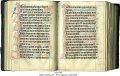
MS in Latin on vellum, England, 3rd quarter of 13th c., 688 ff. (complete), 17x11 cm, 2 columns (12x8 cm), 44 lines in a small and regular Gothic book script, decorated initials throughout with extensive penwork in blue and red, 67 illuminated initials with marginal extensions, 82 historiated initials including the full-margin Genesis initial, illuminated in gold, silver and colours including green.

Binding: England, early 19th c., blue morocco gilt with light blue silk linings, sewn on 3 cords.

Provenance: 1. Thomas Trussel, Middlesex (1331) and Northamptonsshire (1344); 2. William Lighfield, monk of Benedictine Priory of Christ Church, Canterbury (14th c.); 3. Benedictine Priory of Christ Church, Canterbury (14th c. - ca. 1536); 4. William Cockes (16th c.); 5. Henry Munster; 6. Sotheby´s 12.12.1967:19; 7. Sanders, Oxford; 8. Christie´s 9.12.1981:231; 9. Heribert Tenschert, Rotthalmünster.

ms 015
 
back to top top
MS 661    

THE GAETANI BIBLE

BIBLE WITH ST. HIERONYMUS PROLOGUES AND HEBREW NAMES


MS in Latin on vellum, Pisa, Italy, ca. 1310, 500 ff. (complete), 31x23 cm, 2 columns, (20x15 cm), 44 lines in a round Gothic book script of medium quality, signed by the scribe Phylippus on f. 223, red or blue initials with contrasting penwork flourishing in lilac or red, 95 illuminated initials with bar borders of cusped foliage or ivy-leaf sprays, 8 coats of arms in the Genesis initial, marginal notes in a 14th c. Italian loose cursive script.

015

Binding: England, early 19th c., blue morocco gilt with light blue silk linings, sewn on 3 cords.

Context: The 8 coats of arms of the initial for Genesis are: 1. the arms of the Church or the Papacy; 2. the arms of the Empire, presumably Emperor Henry VII (1308-1313); 3. the arms of Pope Clement V (1305-1314); 4. arms representing France; 5. the arms of the Putignanesi family in Pisa; 6. The Gaetani arms borne by pope Boniface VIII (1294-1302); 7. arms of the Gaetani family of Pisa; 8. arms of the counts of Spanheim, used by Lenfant de Spanheim. The presence of the arms of both the Empire and the Church may be an optimistic reflection of the declared intention of Henry VII to settle the discord between the Guelph and Ghibelline factions when he entered Italy in the autumn of 1310.

Provenance: 11. Benedetto(?) Gaetani, canon of Pisa (with the arms of Gaetani family and the Papacy) (ca. 1310-); 2. Scholar at the University of Padua (14th c.); 3. Quaritch Rough List 88(1899?):652; 4. Sotheby's 19.5.1936:9; 5. Otto F. Ege, Cleveland, Ohio (-1951); 6. Sotheby's 11.12.1984:41; 7. Dörling, Hamburg, Auktion 133, 29.11.1989:8; 8. Sam Fogg, London.

ms 661

Commentary: Colophon on f. 223: Finito libro referamus gratias christo. Qui scribsit scribat semper cum domino vivat. Vivat incelis Phylippus nomine felix. During the 13th c. the production of Bibles was so large, that the demand was covered for all of 14th c. and the beginning of 15th c. The making of a major Bible, like the present, in the 14th c. is most unusual. The elegant and unusual illumination has no parallel in other known MSS.

 
back to top top
MS 1368   MS
  1. BIBLE: PSALMS 39 - 150
  2. CANTICLES AND LITANY
  3. TABLE CONTEYNING THE NAMES OF THE PSALMES AFTER THE ORDER OF THE ALPHABET
  4. ORDINAL
MS in Latin and Elizabethan English (text 3) on vellum and paper (text 3), London?, ca. 1320-30, 14th c. (text 4) & late 16th c. (text 3), 112+4 (text 3) ff. (-60), 17x12 cm, single column, (13x7 cm), 20 lines in a rotunda Gothic book script of medium quality, and italic book script (text 3), ca. 1240 linefillers in red or blue including dragons blowing fire, grotesques, heads of kings, bishops, women, fishes, dogs, birds of prey, magpies, jays, thrushes, storks, owls, etc., in endless profusion and variety, 5 large, 4- to 10-line, historiated initials in colours and tracery on highly burnished and tooled gold grounds with branching 3/4 to full borders. MS 1368 - 2

Binding: Probably Belgium, 19th c., dark blue velvet over earlier or possibly medieval wooden boards, sewn on 6 bands.

Provenance: 1. Franciscan Nunnery of the Virgin and St. Francis, without Aldgate, London (ca. 1330- 1539); 2. William Wraye, England (16th c.); 3. Sotheby's 18.6.1991:77.

Commentary: The illumination of the historiated initials with the exaggerated postures of the figures can be compared with those of the Walter of Milemete manuscripts made in London ca. 1326-27, and the borders can be compared with those of the London Liber Custumarum of ca. 1321 (cf. L.M. Sandler. Gothic Manuscripts 1285-1385. 1986, fig. 182 and 221).

MS 1368 - 3
MS 1368 - 4
back to top top

>> OTHER BIBLE TRANSLATIONS