logo homecontents

1.1. The Hebrew and Aramaic Bible

Click on the pictures to view them in full screen format


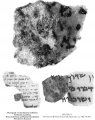
MS 2713

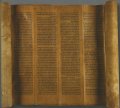
THE JOSHUA DEAD SEA SCROLL

BIBLE: JOSHUA 1:7 - 12; 2:2 - 3

ms2713
MS 2173-2

MS in Hebrew on brown leather, Qumran, late 1st c. BC - early 1st AD, beginning of a scroll, 9,7x17,0 cm remaining, column 1: (5,7x8 cm), 9 lines, column 2: 3 lines, in a fine small Herodian Hebrew book script, + an uninscribed fragment 1,8x1,3 cm.

Context: The original scroll was appr. 5,25 m long, ca. 16,5 cm high, with ca. 55 columns, each ca. 11x8 cm with 16 lines and 1,5 cm between columns, lower edge 4 cm and upper edge ca. 1,5 cm.

Provenance: 1. Community of the Essenes, Qumran (late 1st c. BC-68 AD); 2. Qumran Cave 4? (68-1952); 3. . Khalil Iskander Shahin ("Kando"), Bethlehem (1952-1956); 4. Private collection, Switzerland (1956-1995).

Commentary: There are only 2 other fragmentary Dead Sea Scrolls of Joshua, 4QJosha+b, in Jerusalem: Rockefeller Museum, with parts of the chapters 2, 3, 6-8, 10 and 17, making the present MS the earliest witness to this part of the Bible. With MS 2861 the oldest biblical MS in private ownership.
The text category is proto Masoretic.

Published: James Charlesworth: XJoshva. In: DJD, vol. 38, Oxford 2000, pp. 231-239.

Exhibited: NorFa - Nordic network in Qumran studies. Symposium in Oslo 3-5. June 2004.


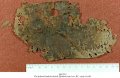
MS 4611

THE LEVITICUS DEAD SEA SCROLL

BIBLE: LEVITICUS 26:3 - 9, 33 - 37

ms4611

MS in Hebrew on light brown leather, Qumran, 30 BC-68 AD, part of a scroll, 9,0x21,2 cm, column I: (5,0x7,2 cm), 9 lines; column II: (5,0x6,5 cm), 8 lines, in a good Herodian Hebrew book script, upper edge preserved 3,8 cm, intercolumn spaces 2,2 - 2,3 - 2,3 cm, blindruled with 4 verticals and 9 horizontals.

Provenance: 1. Community of the Essenes, Qumran (30 BC-68 AD); 2. Qumran Cave 4 (68-1952); 3. Khalil Iskander Shahin ("Kando"), Bethlehem (1952-1956); 4. Private collection, Switzerland (1956-1995).

Commentary: This is a unique, new scroll, not belonging to any other Leviticus scrolls. Leviticus 26:3 - 9 is the earliest witness to this part of the Hebrew Bible, only preceded by the Septuagint 4QLXXLeva (DJD IX:119), dated to 1st c. BC. Leviticus 26:33 is the 2nd oldest witness to the text, only preceded by 4QLev-Numa (DJD XII:23), dated to middle or 2nd half of 2nd c. BC (Early Hasmonaean). Leviticus 26:34 - 37 is the earliest witness to the text.

Published: Émile Puech: Un autre manuscrit du Lévitique, in: Revue de Qumran 21 (2003), 311-313. This was an unauthorized publication, and made without access to the original. The offical publication will be made by Torleif Elgvin in the Manuscripts in The Schøyen Collection series.

Exhibited: NorFa - Nordic network in Qumran studies. Symposium in Oslo 3-5. June 2004.


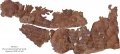
MS 1926/4

THE DANIEL B DEAD SEA SCROLL

BIBLE: DANIEL 3:26 - 27

ms1926

MS in Aramaic on vellum, Qumran, ca. 4 BC-68 AD, 4 fragments sticking together, each 1,8x1,9 cm, of which 3 are inscribed, part of 3+1+2 lines in a Herodian Hebrew book script. The uninscribed fragment, 0,7x2,4 cm, and further a linen cloth 2,2x4,2 cm adhering.

Context: Part of the Dead Sea Scroll 1QDanb=1Q72, of which 2 larger fragments (11,3x9,6 cm 14 lines and 5,8x6,4 cm 7 lines), and ca. 9 tiny fragments (mostly uninscribed) survives, with the text of Daniel 3:22 - 31. Fragment 2 from the present MS matches the largest fragment. They were found in Cave 1 in a lump of vellum consisting of 9 layers also containing 1QDana and 1QPrayers.

Published without the present fragments in: Discoveries in the Judaean Desert I, Oxford 1955, pp. 150-155; and in: J.C. Trever: Completion of the Publication of some Fragments from Qumran Cave I, in: Revue de Qumran, tome 5, no. 19, Nov. 1965.

Provenance: 1. Community of the Essenes, Qumran (ca. 4 BC-68 AD); 2. Qumran Cave 1 (68-1948); 3. George Isha'ya, finder (1948); 4. Syrian orthodox Monastery of St. Mark (Metropolitan Athanasius Samuel), Jerusalem (1948); 5. Gift to John C. Trever, Jerusalem, Claremont and Laguna Hills, California (1948-1994).

Commentary: Daniel 3:26 - 27 is not present on any other Dead Sea Scroll, so this MS is the earliest witness to the text, actually written in the lifetime of Christ and the Apostles.

Originally written 167-164 BC, Hebrew is the original language of Daniel 1:1 - 2:4, Aramaic of 2:4 - 12:13. The present MS is in the original language as well, and copied only about 200 years after the book of Daniel was written.

Published: Dr. Bruce Zuckerman and Dr. Marilyn Lundberg in: The Comprehensive Aramaic Lexicon, Newsletter, no. 12, Cincinnati, Ohio, autumn 1996.

Exhibited: 1. XVI Congress of the International Organization for the study of the Old Testament. Faculty of Law Library, University of Oslo, 29 July - 7 August 1998; 2. NorFa - Nordic network in Qumran studies. Symposium in Oslo 3-5. June 2004.

See also MS 2861, The Judges Dead Sea Scroll, Qumran, 80-30 BC

See also MS 4612, The Joel Dead Sea Scroll, Qumran, 30 BC - 68 AD


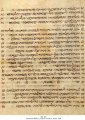
MS 035

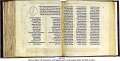
CODEX SINATICUS ZOSIMI RESCRIPTUS

ms035

  1. BIBLE: OLD TESTAMENT LECTIONARY:
    PSALMS 26:7
    PROVERBS 1:15 - 19
    JEREMIAH 1:11 - 17
    DANIEL 3:24 - 37
  2. BIBLE: GOSPELS A:
    MATTHEW 27:8 - 19
    MARK 8:6 - 22; 9:42 -10:2
    LUKE 1:16 - 31; 1:49 - 2:7; 9:7 - 19; 9:32 - 42; 10:12 - 24; 19:48 - 20:14
    JOHN 7:33 - 47
  3. BIBLE: GOSPELS B
    MATTHEW 23:7 - 17; 23:29 - 24:15; 24:45 - 25:10
    MARK 4:7 - 17; 5:31 - 39; 6: 35 - 50; 7:6 - 21; 9:2 - 14; 12:35 - 13: 2; 14:72 - 15:31
  4. ST. CYRIL OF JERUSALEM: CATACHESES: INTRODUCTION CH. 9 - 11; BOOKS 3:5 - 6, 8 - 10; 4:1 - 2; 5:7 - 8; 6:3-4, 24 - 26; 7:7 - 9; 8:3 - 5; 10:18 - 19; 12:13 - 15, 30 - 32; 13:31 - 33; 14:21 - 22; 15:20 - 22; 16:26 - 28; 17:12 - 15. QUOTING: EXODUS 20:19, 31:3; NUMBERS 11:28 - 29; DEUTERONOMY 5:26, 32:6; ISAIAH 64:8; DANIEL 7:9, 10:12; PSALMS 118:91, 118:176; SONG OF SONGS 5:1; MARK 10:58; MATTHEW 6:9, 10:28, 21:31, 25:6 - 7; LUKE 23:42; JOHN 14:16, 20:17; ACTS 2:2, 9:21; 1 CORINTHIANS 15:9; 1 THESSALONIANS 4:15; 1 TIMOTHY 1:13
  5. HOMILY COMPARING THE CHURCH TO A THRESHING FLOOR, WINE-PRESS AND OIL-PRESS. QUOTING: GENESIS 49:11; EXODUS 25:40; NUMBERS 26:10; PSALMS 68:32; ISAIAH 63:1-2; MATTHEW 3:12-13, 5:15, 6:32 - 33; LUKE 11:2; ROMANS 8:26 - 27; 1 CORINTHIANS 12:4, 12:10; HEBREWS 8:5
  6. BIBLE: GOSPEL LECTIONARY, "GOSPELS FOR THE HOLY RESURRECTION ACCORDING TO THE 8 MODES"
  7. BIBLE: GOSPEL LECTIONARY, "GOSPELS BELONGING TO THE LITURGY, 8 PERICOPES ACCORDING TO THE MODES AND THE OCTAVE"
  8. PIMEN: TEACHINGS (THE SAYINGS OF THE HOLY CHURCH FATHER FROM SYRIA TEACHING IN EGYPT)
  9. ARSENIOS: LETTERS (CONTAINING ASCETICAL INSTRUCTIONS FOR MONKS)
  10. IOANE ZOSIME: PRAYERS AND COLOPHON WITH LIST OF CONTENTS

ms035MS palimpsests on vellum, Mt. Sinai, Egypt. Texts 1-5 (underlying text): comprising parts of 5 different MSS, all in Christian Palestinian-Aramaic, 6th c., 2+11+13+16+7 full ff. and 1/2 f. 14x19 cm - 31x20 cm, originally 32x23 cm - 35x24 cm, 2 columns (originally 19x14 - 25-20 cm), 11-25 lines, originally 22-25 lines in Christian Palestinian-Aramaic uncial, 3 decorated crosses (2 of these are used for the book label of The Schøyen Collection). Texts 6-10 (overlying text): in Georgian, dated 979, 70 ff. (incomplete), 20x15 cm, single column, (17x12 cm), 22-26 lines in Khutsuri book script (Georgian ecclesiastical minuscule), by Johannes Zosimos, rubricated.

Binding: Mt. Sinai, Egypt, 979, black leather and linen from mummy wrappings over stout palm wood board, chain stitches on 5 sewing stations, bound and signed by Johannes Zosimos. Hole in bottom outer corner for a chain, iron nail with a conical head for a leather strap. Upper cover complete, lower cover with original leather over 19th c. wood, rebacked, the cords fastened to the cover with small loops of thinner cord, headband coloured red, blue and yellow. Pastedown of other leaves of the MS (6th c.).

Context: Another 1 1/2 ff.=MS 36 are from MS no. 3 (text 3), and 1/2 f.=MS 37 is from MS no. 4 (text 4) of the original codices of 6th c.;16 1/2 ff., also from the same codices, in St. Petersburg, The National Library of Russia (mostly St. Cyril: Catacheses), brought to St. Petersburg from Mt. Sinai in 1859 together with Codex Sinaiticus by Konstantin von Tischendorf. Further 1/2 + 1/4 f from MS no. 3 (text 3) are in Göttingen: Niedersächsische Staats- und Universtätsbibliothek.
Further MSS from Mt. Sinai see MSS 36, 37, 571-585, 613 and 2530.

Provenance: 1. Monastery of St. Catherine, Mt. Sinai (6th-19th c.); 2. Friedrich Grote, Germany (ca. 1900); 3. Private collection, Berlin (1929); 4. D. MacLaren; 5. Sotheby's 12.4.1954:302; 6. Dr. Otto Fisher, Detroit; 7. H.P. Kraus, "Monumenta Codicum Manuscriptorum" cat. (1974):2; 8. H.P. Kraus cat. 165(1983):28.

ms035c

Commentary: Underlying texts: All 5 texts are the earliest extant in Christian Palestinian-Aramaic. Text 4: Addresses Delivered by St. Cyril in 348 AD to Candidates for Baptism. Text 5 is unique. Gospels of 6th c. in this rare language, closely related to the mother tongue of Christ, are of considerable textual interest. The script is together with the nearly identical one in "Codex Climachi Rescriptus", Mt. Sinai, mid 6th c., considered the finest and earliest specimen of Christian Palestinian-Aramaic uncial extant. Apart from the 3 MSS in The Schøyen Collection, only the Vatican, St. Petersburg and Mt. Sinai libraries have MSS in this language and script, and even the Mt. Sinai library has only 3, all from 11th c. Overlying texts: Text 8 is unique, cf. MS 37. Text 9 is the oldest of the 3 extant. Text 10: This colophon extends over 3 pages, dated twice, Mt. Sinai 979. There are 20 MSS from Mt. Sinai in The Schøyen Collection. Besides the monastery's own famous library (4300 MSS), only British Library (8 MSS) and The National Library of Russia, St. Petersburg (69 MSS, mostly fragments), have comparable holdings.

Published (underlying text): Alain Desreumaux: Codex sinaiticus Zosimi rescriptus; Description codicologique de feuillets araméens melkites des manuscrits Schøyen 35, 36 et 37. In: Histoire du Texte Biblique 3. Lausanne, Éditions du Zèbre, 1997.

Land: Examinantur fragmenta syropalaestina; in: Anecdota Syriaca, IV, 1875. Orthodox Palestinian Society, ed.: Orthodox Palestinian Collection, vol. IV. St. Peterburg 1888, p. 233 no 81 (In Russian).

Hugo Duensing: Christlich-palästinisch-aramäische Texte und Fragmente. Göttingen 1906.

Exhibited: 1. Conference of European National Librarians, Oslo. Sept. 1994; 2. XVI Congress of the International Organization for the study of the Old Testament. Library of Law Faculty, University of Oslo, 29 July - 7 August 1998.


MS 1630

ms1630

  1. BIBLE: AMOS 5:7 - 9:8
  2. BIBLE: ZECHARIAH 13:7 - 14:21
  3. BIBLE: MALACHI 1:1 - 2:10

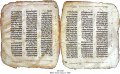
MS in Hebrew on vellum, Iraq, ca. 1000, 4 ff., 40x35 cm, 3 columns, (27x25 cm), 22 lines in a large formal oriental square Hebrew book script with nikud (vowel points), Masora Magna in upper and lower margins, and Masora parva in outer margins.

Binding: Barking, Essex, 1996, red cloth gilt folding case by Aquarius.

Context: The most similar dated MS is the Codex Ben-Asher (MS Cairo, Karaite Synagogue), dated Tiberias 895, now proved to be wrong, the MS probably is 10th c. or ca. 1000.

Provenance: 1. Quaritch, London.

Commentary: These leaves are contemporary with the Leningrad Codex, dated 1009, which is the main MS used for the text of the Old Testament of our Bible today. It is the oldest complete Old Testament MS extant, and, like the present 4 ff., textually of the highest class, following the Masoretic tradition closely.

Very unusually the present MS spells in one case the Holy Name with 4 dots surmounted with 4 yods, i.e. it is not to be pronounced. The use of 4 dots without Yods is attested in a few Dead Sea Scrolls, such as IQS, col. 8, line 14. In the remaining cases it actually vocalizes the Holy Name.

Exhibited: XVI Congress of the International Organization for the study of the Old Testament. Library of Law Faculty, University of Oslo, 29 July - 7 August 1998.


MS 201

BIBLE: LEVITICUS 13:56 - 15:15

ms201

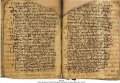
MS in Hebrew on vellum, Ascalon, Israel, 1189, 4 ff., 28x24 cm, single column, (18x15 cm), 24-25 lines in a bold Samaritan square book script, by the scribe Ab Hasta, son of Abnef Uscha.

Provenance: 1. Maggs European Bulletin 13(1986):18; 2. Maggs Cat. 1073(1987):3.

Commentary: This is one of the oldest survivals of the Samaritan Pentateuch in codex form. The oldest is Cambridge University Library from 1149/50 or earlier. The oldest surviving scroll is 11th c. The Samaritans were separated from the Jews 4th – 2nd c. BC. Being extremely conservative, they preserved both a very archaizing form of the Hebrew script, and the original text of the Hebrew Pentateuch, confirmed by its agreements with the Qumran texts, and some Jewish texts that escaped revision by official Judaism.

Exhibited: XVI Congress of the International Organization for the study of the Old Testament. Library of Law Faculty, University of Oslo, 29 July - 7 August 1998.


MS 5070

BIBLE: OLD TESTAMENT (THE HEBREW BIBLE: THE LAW AND THE WRITINGS WITHOUT THE PROPHETS) WITH MASORA PARVA AND MAGNA

ms5070ms5070

MS in Hebrew on vellum, Spain, 2nd half of 13th c., 264 ff. (-40), 37x35 cm, 3 columns, occasionally 1 or 2 columns, (26x25 cm), 24 lines in a square Spanish Hebrew book script by 1 scribe, occasional penwork decorations; 5 additional ff., autograph notes by Sir Frederick Madden, 1826.
Binding: Liverpool, England, 1820-1830, dark blue morocco gilt on wooden boards, central panel with ostrich, crest A of Thomas William Coke, bound by Jones.

MS 5060

Provenance: 1. The Holkham Library, MS 2, the 1st to 6th Earls of Leicester, Holkham Hall, Norfolk (ca. 1730-2002); 2. Quaritch, London.

Commentary: The scribe provided a 12-line poem in which he comments on his writing of the text and his methodology. According to Madden's notes the MS has Masoras that he had not found in any other MS. This majestic Bible is part of the tradition of the great format Bibles, initiated in Castilla and Aragon in the 13th c. The unusual layout with 3 columns goes back to the earliest codices of the Hebrew Bible from the Near East from 10th-11th c., which origin from the earlier scroll format, cf. MSS 1630, 1858/3 and the Dead Sea Scrolls MSS 2713 and 4611. With its about 600 MSS The Holkham Library remains the largest and finest manuscript collection in private ownership in the British Isles, see W.C. Hassall, The Holkham Library, Illuminations and illustrations in the manuscript library of the Earl of Leicester. Oxford, The Roxburghe Club, 1970.

Exhibited: NorFa - Nordic network in Qumran studies. Symposium in Oslo 3-5. June 2004.


Top      Next collection