logo homecontents

22. Buddhism

Click on the pictures below to view them in full screen format

Introduction

The Schøyen Collection contains about 1500 Buddhist manuscripts from most Asian countries spanning nearly 2000 years. The Buddhist Scriptures collection starts with the foundation manuscripts of Mahayana Buddhism, and is represented here by 14 manuscripts. In addition, large parts of the China collection and Pre-Gutenberg Printing collection are also examples of Buddhist literature.
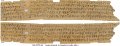
Foremost is a collection of manuscripts found in caves in Bamiyan, in Afghanistan, in 1993-95. They comprise around 5,000 leaves and fragments, with around 7,000 micro-fragments, from a library of originally up to 1,000 manuscripts. These manuscripts, together with 60 in the British Library, have been called the "Dead Sea Scrolls of Buddhism". They are the earliest Buddhist scriptures known, spanning the 2nd to 7th centuries AD, and are written on palm leaf, birch bark, vellum and copper.

This material largely avoided destruction during the recent civil war (between several local war lords and the Taliban) by being taken out of the war zone. However, significant parts that remained in Afghanistan when the Taliban took power in most of the country in 1996 were earmarked for destruction, together with other Buddhist objects and monuments. The Collection played a major role in rescuing these items for scholarship and for the common heritage of mankind. The first fragments were acquired by the Schøyen Collection in the summer of 1996 from the London bookseller Sam Fogg’s Cat 17 lot 39. The bulk of the material was acquired in London between 1997 and 2000.

At the time of acquisition, the material was increasingly in danger of being dispersed across a fast growing number of people spread over many countries. Many of the micro-fragments were either being discarded or used for as amulets. The greatest challenge of a rescue operation turned out to be getting the materials together again. For the greater part, this was achieved. As the last part of the rescue operation, the manuscripts will now be made available to everyone, and will be published by the world's leading scholars.

Compliance with the law is a matter of great concern to the Schøyen Collection. When it was drawn to the attention of the Collection that some items might have arrived from Gilgit in Pakistan and been illegally exported, the Collection immediately returned these items to Pakistan through their Ambassador to Norway. The Pakistan Government was highly appreciative of this act of good faith to the country.

The right of title of the Schøyen Collection in law is unquestioned. Every item was acquired legally from London dealers before the accession of the UK, Norway or Afghanistan to the 1970 UNESCO Convention or the 1995 UNIDROIT Convention. It is important to understand that these items appeared on the antiquities market as refugee items from the Taliban and that the entire collection was in danger of being dispersed in a way that would almost certainly have meant a major loss to Buddhist scriptural scholarship.

The Buddhist manuscripts are the only section in the Collection that were specifically acquired to prevent destruction, after requests to do so were received from Buddhists and scholars. Should these MSS be returned to Afghanistan after they have been published – or at least as soon as peace, order, religious tolerance, and safe conditions can be reliably established in that country? Unfortunately, few commentators consider that those conditions now apply, regardless of specific claims in regard to the capital city, Kabul. Moreover, there are historical facts that bear on the question of whether the manuscripts should be returned to present-day Afghanistan.

The manuscripts were produced at the time of the Kushan Indo-Scythian Empire, later conquered by the Huns. Modern Afghanistan did not exist. The area has since changed religion from Buddhism to Islam, and its languages from Sanskrit and Gandhari to Arabic, Dari and Pashtu. Most of the cultural descendants of the original Buddhists now live outside Afghanistan. More than half of the manuscripts were actually written in what is now Pakistan and India.

More tragically, the Buddhist monasteries and their manuscripts were mostly destroyed in the 8th century by Muslim invaders. The remaining sites were, to a greater extent, destroyed by the Taliban very recently, including, most infamously, the two giant statues of the Buddha that were blown up in 2001. In the last 2000 years, the region that is now Afghanistan has been regularly conquered, and shaken apart by strong neighbours to the East, North, and West – and it has been frequently torn apart by civil wars. The region’s geopolitical and physical situation continues to be an intractable issue.

Despite the statements of current interested parties, there is still no evidence that full stability is likely or achievable in the next few years. Instability is also a concern in some of the bordering countries. For these reasons and in full awareness of its global heritage duties, the Schøyen Collection cannot consider Afghanistan a safe home for these manuscripts in the future. This policy position has been taken with full respect for the current Government of Afghanistan which is working hard to achieve peace and stability under very difficult circumstances.

The Collection feels a strong sense of responsibility for the safekeeping of the Buddhist manuscripts from Bamiyan that have survived over the centuries, and often against the odds, for some 1500 years. The Schøyen Collection’s duty of care fundamentally involves full and careful assessment of the risks of onward transmission of any of its acquisitions.

Even if a UNESCO convention dictated that such artefacts be returned to nation-states, this is an ideological determination. Any such determination says nothing about whether a particular nation-state is, in reality, in a position to safeguard precious and historically significant cultural objects which may have little to do with its current culture. The cultural property environment is riddled with politically motivated but badly thought out initiatives. While the Schøyen Collection will always comply with the law in every jurisdiction in which it operates, it will exercise its right to speak openly where it sees a wrong being perpetrated against the wider global public interest of preserving important examples of all the world’s cultures and religions, without fear or favour towards any particular culture, religion or ideology. The qualifications for stewardship of important cultural relics must include:

The Schøyen Collection is actively engaged in seeking the best means of ensuring a safe and secure home for the manuscripts and it recognizes the aspirations in this regard of the current legitimate Afghan Government as well as those of the global Buddhist community and of scholarship in general. It has maintained close and friendly contacts with the Afghan Embassies in Norway and France to this end.

In the same spirit, the Schøyen Collection transferred seven fragments that had already been published in 1932 and were part of the Hackin Collection, to the Afghan National Museum on September 5, 2005. These fragments were held by the Schøyen Collection on behalf of the Museum for security and preservation reasons only: they were never part of the Schøyen Collection itself. As an additional gesture of goodwill, the Collection also generously offered to present the Museum with a further 43 or 44 manuscript fragments of similar type as those that once were in the Hackin collection, but which were destroyed in the war. This will bring the Museum’s holdings back up to its pre-war level of around 50 fragments.

The Afghan authorities accepted the gift, and in accordance to the commitment of 2005 the actual presentation of a gift of 58 Buddhist fragments took place on 15 February 2008 to H.E. Jawed Ludin, ambassador at the Embassy of the Islamic Republic of Afghanistan in Oslo, on behalf of the National Museum of Afghanistan in Kabul. Afghanistan duly thanked The Schøyen Collection for its generous contribution to further enriching the valuable collections of the Museum, which is reviving after severe damage suffered during the War. The Schøyen Collection is honoured to have had the opportunity to restore the Museum's holding up to and even above its pre-war holdings. The Afghan authorities have expressed their appreciation both of the research that has been undertaken over many years and of the publication of the Buddhist manuscript fragments by Professor Jens Braarvig and an international group of scholars. Details of the donation and other announcements are available in the NEWS section.

In conclusion, the Schøyen Collection has a responsibility for the safekeeping of manuscripts that have survived up to 5000 years, and wishes these manuscripts at least an equally long life in the future, with full access for scholars and others with a valid interest in their study and preservation, irrespective of nationality, race or religion. Nation-states that come and go with the ebb and flow of history – and the organisations under the control of nation-states – are not the only qualified keepers of world heritage artefacts.


The Collection


22.1. Agama sutras

22.2. Mahayana Prajnaparamita sutras

22.3. Mahayana sutras

22.4. Vinaya

22.5. Abhidarma

22.6. Tantra

22.7. Various Buddhist literature


Top      Next collection