THE HISTORY OF WESTERN SCRIPT IV
Passing on the mantle of care and ownership of an unequalled private collection
Sixty manuscripts from the Schøyen Collection were offered at auction on 7 December 2021 with some lots attracting bids more than triple their estimates, with all manuscripts sold. The sale followed another held in July 2020 in celebration of the collector’s 80th birthday. Both auctions were accompanied by catalogues – The History of Western Script III and The History of Western Script IV – providing important textbook references of Western palaeography for students and scholars, in keeping with the objectives of the Collection’s owner, Dr Martin Schøyen.
One of the highlights of the 2021 auction – a rare example of ‘printed’ reverse-mould on gold foil with six lines in Doric Greek of an Orphic poem in iambic trimeters dedicating a traveller’s staff to Apollo printed in Greece or Asia Minor in the 4thcentury AD – fetched £59,500 (with aggregate). Alongside the famous Phaistos Disc from Crete, this sparkling gold lamella is possibly the earliest example of printing in blind in Europe, produced over a thousand years before Gutenberg.

An exceedingly rare item – a previously unrecognised leaf recording pre-Carolingian liturgy, once part of either a copy of the Gelasian Sacramentary or an ordines Romani – sold at £21,250 (with aggregate), more than double the estimate. Only a tiny handful of similar examples exist and no other has come to the market until now.

Half of the sale consisted of mostly English medieval charters, which did exceptionally well. Some, like the documents concerning the Dukes of Burgundy (Lot 52), tripled their estimates.
Dr Schøyen said: “Saying farewell to old friends, which is what some of these manuscripts have become, is poignant. But as the knowledge they contain becomes recorded in a growing number of publications available for scholarly reference and further research – and now that I am an octogenarian – I am pleased to pass the mantle of care and ownership to the safe haven of other collectors, private and institutional.”
Highlights of last year’s auction included the only surviving records of Taunton Priory, a significant religious house before the Dissolution, and the Darley Abbey Archive, both well exceeding their estimates at auction.
Dr Schøyen added: “I have spent some 60 years systematically assembling the most comprehensive collection of manuscripts from around the world as a record of human history and culture over 5000 years. My motivation for collecting has always been preservation, research and publication. Even an apparently insignificant leaf of parchment can hold as much history and impart as much knowledge as a well-known item. Some of the manuscripts that have been auctioned in 2020 and 2021 reflect important historical Ecclesiastical developments. Others offer fascinating insights into what people believed, how people thought and how they were governed in pre-modern times.”
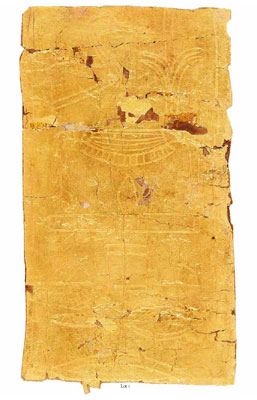 Also sold at auction this year was a gold foil sheet with the name of the Princess Nubhetepti-khered in hieroglyphs, a funerary object from a tomb in the royal necropolis of Dahshur, next to some of the oldest and best preserved pyramids in ancient Egypt as well as numerous graves of royal women renowned for the splendour of their jewellery and ornaments. Princess Nubhetepti-Khered was probably the daughter of Kind Hor who reigned around 1777-1775 BC. It is likely that this object was discovered during the de Morgan’s excavations at Dahshur in 1894.
For a full account of the 2020 auction: https://auctions.dreweatts.com/past-auctions/blooms1-10012
For a full account of the 2021 auction: https://auctions.dreweatts.com/auctions/8014/blooms1-10017
Note to Editors:
The Schøyen Collection crosses borders and unites cultures, religions and unique materials found nowhere else. The Collection, based in London and Oslo, contains over 20,000 significant manuscripts and other artefacts of cultural importance to the world’s heritage.
There has been no public collection with the Schøyen Collection’s unique array of manuscripts and with such a variety, geographically, linguistically and textually, of scripts and writing materials, covering so a great span of time — 5,000 years of history.
| Research and General Enquries research@schoyencollection.org |
|
| Media and Picture Requests | |
| Schøyen Collection Press Office + 44 (0) 7971551778 pressoffice@schoyencollection.org |